
New Delhi: HL 07 July, 2026
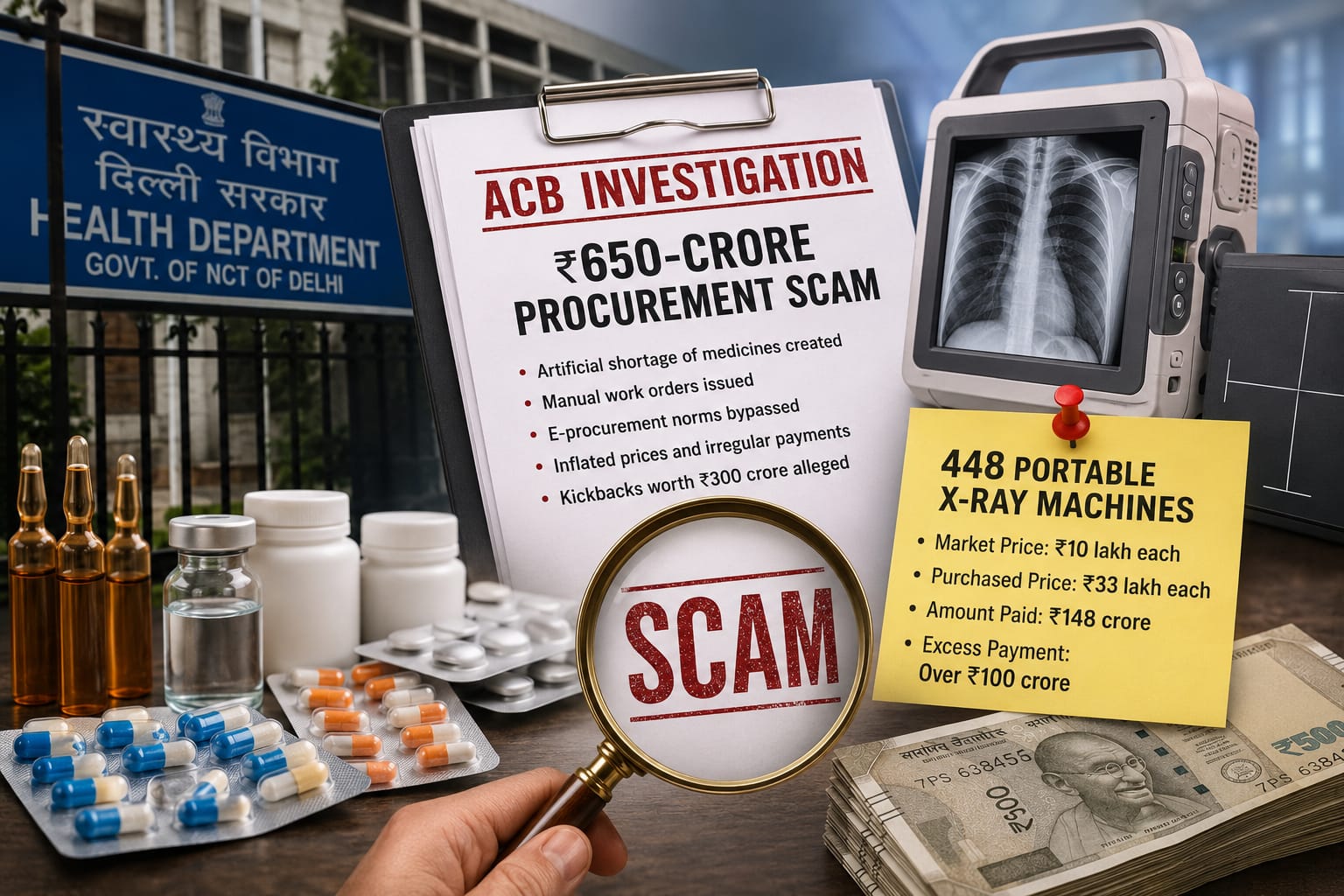
The Anti-Corruption Branch (ACB) investigation into the alleged Rs. 650-crore procurement scam in the Delhi government’s Health Department has uncovered what investigators describe as a coordinated pattern of irregularities involving medicine procurement, emergency purchases, inflated pricing and questionable tender practices. The findings, detailed in the ACB FIR and a stock audit, point to alleged manipulation of the procurement process that caused significant losses to the public exchequer.
According to the FIR, senior officials of the Health Department allegedly worked in collusion with private suppliers to create an artificial shortage of medicines and surgical equipment in government hospitals. Investigators claim the shortages were deliberately engineered so that emergency purchases could later be made at substantially higher prices.
The FIR alleges that mandatory e-procurement norms were bypassed and manual work orders were issued to preferred firms. Former Central Procurement Agency (CPA) in-charge Dr. Vinod Kumar Ranga and former Director General of Health Services Dr. Vatsala Aggarwal have been named in the investigation for their alleged role in approving procurement outside the prescribed online system.
Investigators further claim that tender records on the government procurement portal were manipulated by showing contracts as “pending”, “rejected” or “under process” even after supplies had been completed and payments released. According to the FIR, this allegedly concealed contract details from competing bidders and the public.
Emergency Purchases at Inflated Rates
The ACB alleges that state-level tenders for medicines were intentionally delayed, leading to shortages across government hospitals. The resulting emergency procurement of medicines and surgical equipment was allegedly carried out through local purchases at prices 70-80% higher than approved tender rates. Investigators estimate that these purchases alone may have resulted in an additional expenditure of nearly Rs. 400 crore.
The FIR also alleges that the procurement process enabled kickbacks of around Rs. 300 crore, allegedly shared between corrupt officials and supplier Rajiv Singla. It further claims that tender documents were drafted by the supplier himself and that members of tender committees who questioned the process were allegedly pressured or threatened with disciplinary action.
Investigators have also alleged selective release of payments. While bills of several pharmaceutical companies were reportedly withheld for nearly two years, payments to firms linked to Rajiv Singla were allegedly cleared immediately, particularly after October 2025.
448 Portable X-Ray Machines Under Scanner
One of the biggest financial irregularities highlighted in the stock audit relates to the procurement of 448 portable X-ray machines.
According to the audit, the same model manufactured by Pronosis Medical Systems was being supplied to other government institutions for nearly Rs. 10 lakh per machine. However, instead of purchasing directly from the manufacturer through the CPA, the Delhi Health Department allegedly procured the machines through Delhi-based intermediary F-Med Devices at around Rs. 33 lakh per unit.
The audit estimates that while the actual value of the machines was about Rs. 45 crore, payments amounting to nearly Rs. 148 crore were released. Investigators suspect that over Rs. 100 crore may have been paid in excess and are examining whether the amount was diverted through an alleged kickback network.
The investigation has expanded beyond procurement records to include the role of officials involved in technical evaluation, purchase approvals, payment clearances, supply chain management and their alleged links with the firms concerned.
Questions Over Middleman’s Role
The investigation has raised several key questions, including why the machines were not purchased directly from the manufacturer and why F-Med Devices, a proprietorship firm based in Laxmi Nagar, was included in the procurement chain.
According to audit findings, tender conditions may have been framed in a manner that restricted competition, leaving F-Med Devices as the only technically qualified bidder. Supplies were allegedly made soon after the contract award, with payments released without significant delay.
Investigators are now scrutinising the complete procurement chain, including tender drafting, technical qualification, price determination, commercial agreements, payment approvals and financial transactions.
Early Warning Signs Allegedly Ignored
The stock audit also points to warning signals that surfaced in 2024 but allegedly did not receive timely attention.
Departmental records show that on January 30, 2024, the ACB sought original procurement and supply records from Deen Dayal Upadhyay (DDU) Hospital after quality testing reportedly found that samples collected by the Health Department’s vigilance branch had failed prescribed standards.
The records also refer to an incident involving medicines worth nearly Rs. 70 lakh, initially reported as theft from DDU Hospital. Investigators are now examining whether the medicines were ever supplied, with allegations suggesting the reported theft may have concealed procurement irregularities.
Officials associated with the investigation believe that prompt action on these early complaints could have exposed the alleged procurement scam much earlier.
The ACB continues to examine procurement files, payment records, tender documents and financial transactions as part of its ongoing investigation. The allegations are based on the ACB FIR and stock audit findings, and the matter remains under investigation. No court has yet reached a final conclusion regarding the allegations.