
By Ekta
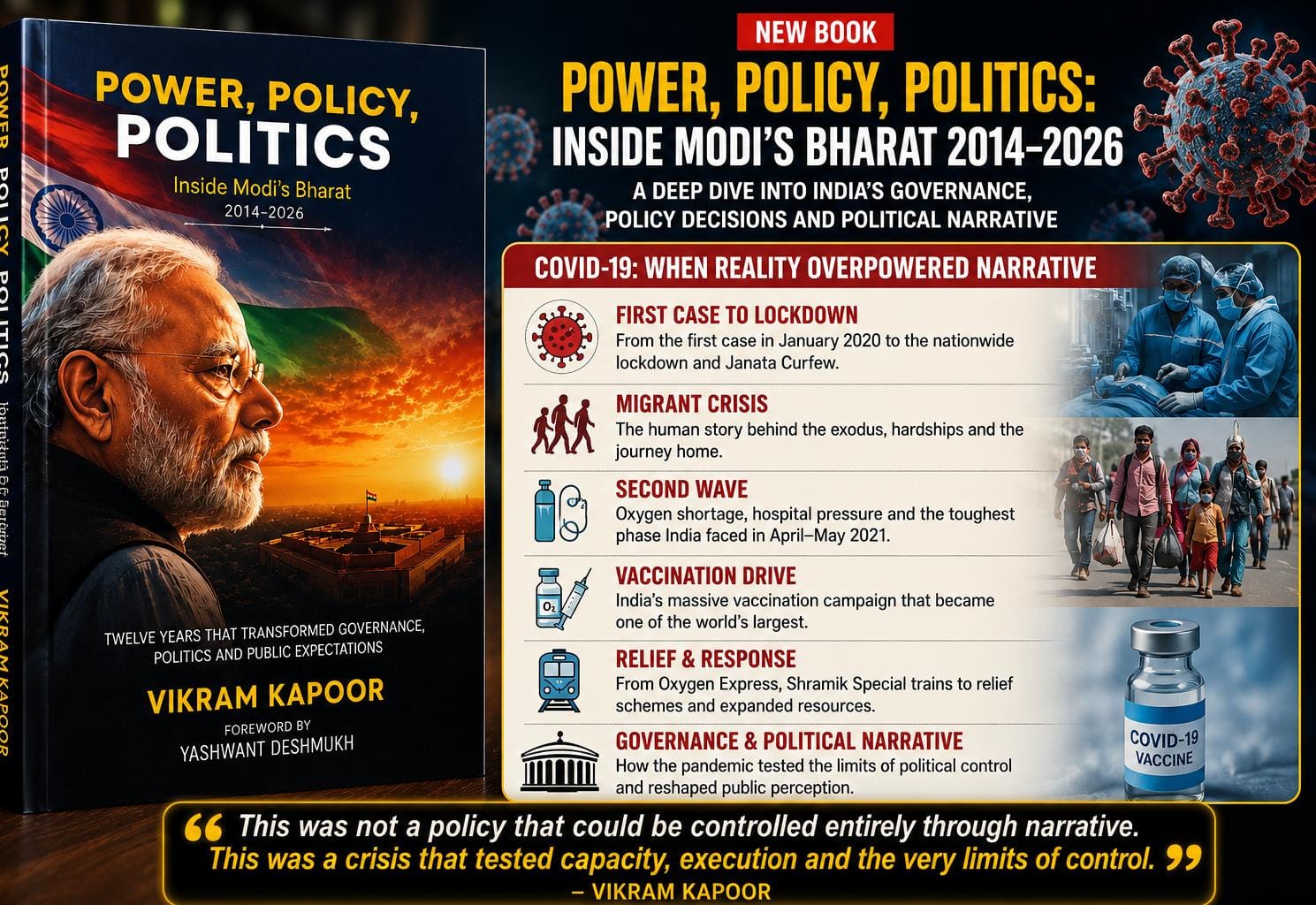
New Delhi: A new book, “Power, Policy, Politics: Inside Modi’s Bharat 2014–2026” by Vikram Kapoor, takes a close look at the evolution of governance, policy and political communication in India during a transformative period. One of its chapters, titled “COVID: When Reality Overpowered Narrative,” examines the COVID-19 pandemic through the lens of policymaking, administration, public perception and lived experience.
The chapter follows India’s pandemic journey from the detection of its first confirmed COVID-19 case in Kerala in January 2020 through the nationwide lockdown, migrant crisis, second wave, oxygen shortage and mass vaccination campaign.
According to the book’s narrative, the pandemic initially appeared to be a developing health story while India’s political cycle remained focused on the Delhi elections and the ongoing CAA protests. That changed dramatically in March 2020 as the scale of the pandemic became increasingly apparent.
The chapter recalls the Janata Curfew on March 22, 2020, followed two days later by the announcement of a nationwide lockdown. The author describes the sudden transformation of Delhi’s streets, with normally busy roads and markets becoming almost deserted.
The migrant crisis changed the picture
A major focus of the chapter is the migrant-worker crisis that unfolded after economic activity came to a halt.
Kapoor describes travelling along a highway leading out of Delhi in late March and early April 2020 and witnessing families attempting to return to their home states on foot. The account highlights how the crisis exposed vulnerabilities that went beyond the immediate public-health emergency.
The book also discusses the government’s subsequent relief measures, including the Pradhan Mantri Garib Kalyan Yojana, expansion of food support, direct cash transfers and, later, the introduction of Shramik Special trains to transport migrant workers to their home states.
The author’s central observation is that government action was evolving while the situation itself was already escalating rapidly. Rather than presenting migrant workers merely as victims of the lockdown, Kapoor uses the episode to examine a deeper problem: the gap between announcing policy and executing it across a country of India’s scale.
His encounter with a migrant worker who simply says “चलते जाएंगे” (We will keep walking) becomes a symbolic moment in the chapter. Kapoor interprets it as evidence of structural vulnerability rather than merely a political controversy.
The devastating second wave
The narrative then moves to the second wave of COVID-19 in 2021, when India experienced an unprecedented surge in infections.
Kapoor recalls the situation in Delhi during April and May 2021, when hospitals faced enormous pressure and demand for oxygen, medicines and hospital beds surged. Social media, the chapter notes, increasingly became an informal network connecting people seeking urgent assistance with those able to provide it.
The account also becomes personal, with the author describing how COVID-19 eventually affected members of his own family.
A conversation with a Delhi doctor during the peak of the second wave is presented as an illustration of the pressure faced by the healthcare system. The chapter uses this experience to argue that the pandemic could not be understood simply through political messaging because its consequences were immediate and personal.
The doctor’s statement: “हम मरीज चुन रहे हैं”
This is potentially one of the chapter’s most powerful human details. The doctor tells Kapoor, “हम मरीज चुन रहे हैं” — “We are choosing patients.”
Kapoor uses this not to claim that the system completely collapsed, but to illustrate a healthcare system operating beyond normal capacity. That distinction is important and gives the chapter a more nuanced character.
From crisis management to vaccination
The book also records the government’s efforts to expand resources during the second wave. These included measures to strengthen oxygen supply chains, the deployment of Oxygen Express trains and the creation of temporary medical facilities.
Alongside emergency measures, the vaccination campaign that began on January 16, 2021, was accelerated. The chapter highlights the scale of India’s vaccination programme and its expansion through 2021 and into early 2022.
As the immediate crisis eased, the public narrative also began changing. The focus gradually moved from hospital shortages and emergency response to vaccination, economic recovery and the reopening of normal activities.
When reality overpowers narrative
The central argument of the chapter is reflected in its title: “COVID: When Reality Overpowered Narrative.”
Kapoor argues that political narratives can influence public perception, but a crisis of the scale of COVID-19 ultimately confronts governments with realities that cannot be completely managed through communication.
The pandemic, according to the chapter, demonstrated both the strengths and limitations of India’s administrative capacity. The ability to take rapid decisions, including the nationwide lockdown, reflected decisiveness, while the migrant crisis and the second wave exposed challenges in executing policy at enormous scale.
At the same time, the author points to the system’s ability to adapt. Policies were adjusted, resources were expanded and new mechanisms were developed as circumstances changed.
A rare acknowledgement of both strengths and weaknesses
The book does not portray the pandemic response as entirely successful or entirely unsuccessful. It identifies:
Strengths: rapid decision-making, lockdown, adaptation, expansion of resources, vaccination at enormous scale.
Weaknesses: migrant distress, implementation problems and the healthcare system’s inability to absorb the second-wave shock at scale.
That balanced framing is arguably more interesting than a conventional political narrative.
A political lesson from the pandemic
The chapter concludes with a broader reflection on governance and politics. COVID-19, Kapoor suggests, tested the boundaries of political control and demonstrated that lived experience can ultimately reshape public perception.
The pandemic therefore becomes more than a chapter about a health emergency. In the context of Power, Policy, Politics: Inside Modi’s Bharat 2014–2026, it becomes a case study of how governments, political narratives and administrative systems respond when confronted with a crisis that affects virtually every section of society.
The book’s COVID chapter offers a retrospective view of one of the most consequential periods of contemporary Indian governance, examining the distance between policy announcements, implementation on the ground and the experiences of citizens.

Book: Power, Policy, Politics: Inside Modi’s Bharat 2014–2026
Author: Vikram Kapoor
Featured chapter: COVID: When Reality Overpowered Narrative