
By Sandeep/ New Delhi: November 26, 2026
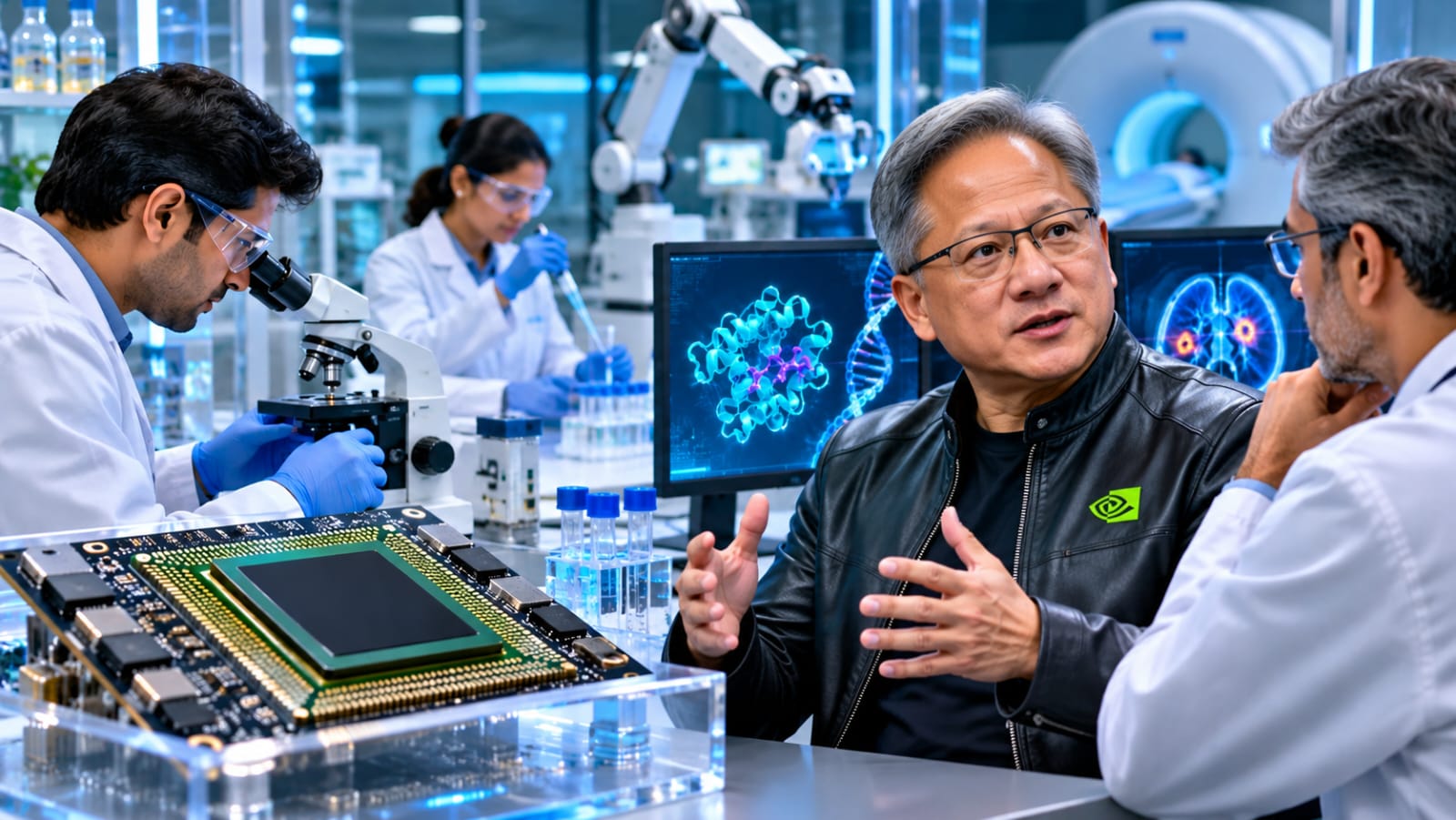
Artificial intelligence is opening a new chapter in modern medicine, and American technology giant NVIDIA is positioning itself at the centre of this transformation. The company is expanding its presence in healthcare and life sciences through collaborations aimed at accelerating drug discovery, improving cancer treatment and making scientific research more efficient.
In a major development announced on October 21, 2026, NVIDIA unveiled collaborations with healthcare and research organisations to advance protein design, pharmaceutical research and precision cancer care. The initiatives highlight how advanced computing and AI models are increasingly becoming important tools in medical science.
AI Could Accelerate the Search for New Medicines
One of the most significant developments is NVIDIA’s collaboration with the University of Washington’s Institute for Protein Design to introduce RFD4-Proteina, an open AI model designed to support programmable protein design.
Proteins play essential roles in biological processes, and designing new proteins could open possibilities for developing medicines, diagnostic technologies and new therapeutic approaches.
The model is designed to generate and evaluate potential protein structures, helping researchers explore possibilities and prioritise promising candidates for laboratory testing. This could make early-stage biological research more efficient, although experimental validation and clinical trials remain essential before any treatment can be approved.
New Push Towards More Precise Cancer Treatment
NVIDIA is also collaborating with Siemens Healthineers to advance adaptive radiotherapy, a cancer treatment approach in which radiation plans can be adjusted according to a patient’s changing anatomy and treatment requirements.
The collaboration explores AI-assisted treatment planning, patient-specific simulations and real-time computing. These technologies could help medical teams evaluate treatment strategies, improve workflow efficiency and deliver radiation more precisely to targeted areas while protecting surrounding healthy tissue.
The initiative is particularly relevant as healthcare systems worldwide face growing cancer-care requirements and shortages of specialised medical professionals.
$1 Billion AI Research Partnership With Eli Lilly
NVIDIA’s healthcare ambitions extend beyond medical imaging and hospital technology.
In January 2026, NVIDIA and pharmaceutical company Eli Lilly announced plans to invest up to $1 billion over five years in a joint AI co-innovation laboratory.
The partnership aims to combine pharmaceutical expertise with advanced computing, AI infrastructure and robotics to address challenges in medicine discovery and manufacturing.
The collaboration reflects a growing interest among pharmaceutical companies in using AI to analyse biological information, identify potential drug candidates and improve research processes.
AI-Powered Laboratories and Scientific Research
NVIDIA’s BioNeMo platform is another important part of its healthcare strategy. It provides tools and models for AI-driven biological research and drug discovery.
Several organisations, including Benchling, Danaher, Automata and other biotechnology companies, are exploring AI-powered scientific agents and automated laboratory workflows.
These systems aim to connect computational research with physical experiments, allowing scientists to analyse results and plan subsequent experiments more efficiently.
What Does This Mean for the Future of Healthcare?
NVIDIA’s growing healthcare partnerships indicate that artificial intelligence is moving beyond administrative automation and entering areas that directly support scientific research and clinical care.
Potential applications include:
- Faster identification of promising drug candidates.
- Improved medical imaging and diagnostic support.
- More personalised cancer treatment planning.
- Advanced protein and genomic research.
- Automated laboratory processes.
- Better coordination of hospital operations.
However, AI-generated findings must undergo scientific validation. Medical professionals must remain responsible for clinical decisions, while patient privacy, data security and regulatory oversight will be critical to the adoption of these technologies.
India’s Healthcare Sector Could Also Benefit
For India, the expansion of AI-driven healthcare presents opportunities in medical research, diagnostics, pharmaceutical development and hospital management.
Institutions such as AIIMS and ICMR, along with Indian biotechnology companies, research laboratories and medical technology developers, could explore the potential of advanced computing and AI-based research platforms.
India’s pharmaceutical manufacturing strength and growing digital healthcare infrastructure could create opportunities for collaborations between technology companies, hospitals and research institutions.
The future of healthcare will increasingly depend on the convergence of medicine, biotechnology, robotics and artificial intelligence. NVIDIA’s expanding role in this ecosystem demonstrates how computing companies are becoming important partners in the next generation of medical innovation.