

New Delhi : HL July 9, 2026
The Delhi Government has launched a major crackdown on the quality and storage of Oxytocin, a critical life-saving medicine used during childbirth, with authorities seizing a total of 34,375 injections and ampoules in two separate enforcement actions over concerns related to quality and improper storage.
The action follows directions from Delhi Health Minister Dr. Pankaj Kumar Singh, who has instructed the Drugs Control Department to intensify inspections across the National Capital and take strict action against any violations affecting patient safety.
31,700 Oxytocin Injections Seized Over Cold Chain Violation
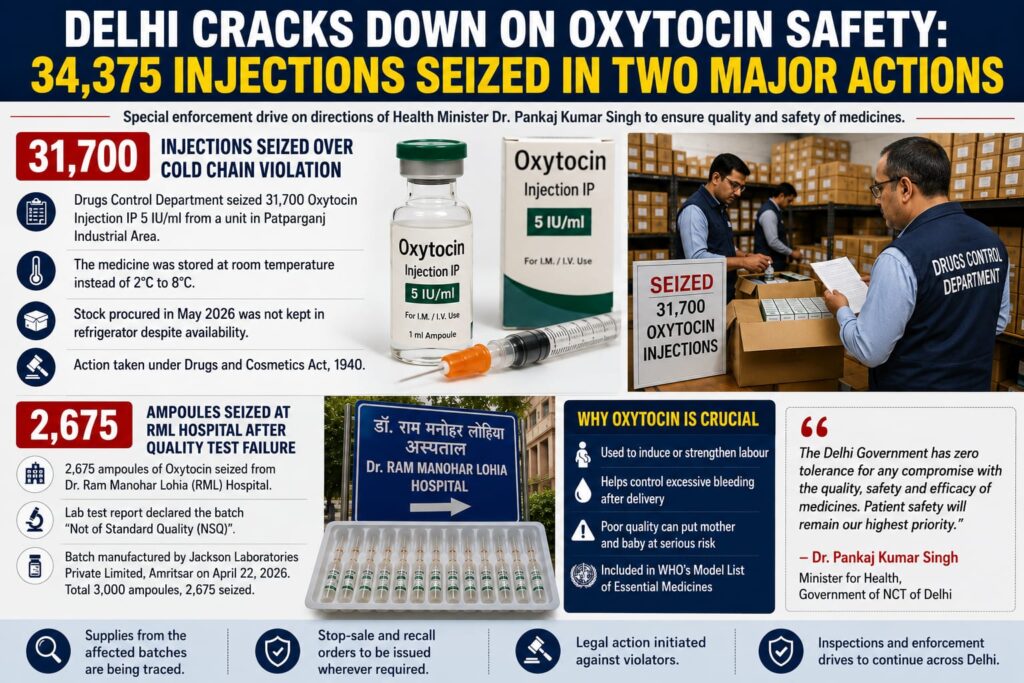
In the first operation, the Drugs Control Department conducted a surprise inspection at a pharmaceutical establishment in the Patparganj Industrial Area, where officials seized 31,700 Oxytocin Injection IP 5 IU/ml after discovering that the temperature-sensitive medicine had allegedly been stored at room temperature instead of the mandatory 2°C to 8°C.
Officials said the stock had reportedly remained under improper storage conditions since May 2026. Although a functional refrigerator was available at the premises, medicines requiring refrigeration were not stored inside it, allegedly violating Rule 65(17) of the Drugs Rules, 1945.
Considering the possibility that prolonged exposure to room temperature could reduce the drug’s potency, the department seized the entire stock under the Drugs and Cosmetics Act, 1940. Authorities are now tracing supplies from the affected batch and have initiated steps to issue stop-sale and product recall orders wherever required.
2,675 Ampoules Seized at RML Hospital After Quality Test Failure
In a separate case, the Drugs Control Department seized 2,675 ampoules of Oxytocin from Dr. Ram Manohar Lohia (RML) Hospital after laboratory testing declared the batch “Not of Standard Quality (NSQ).”
According to officials, preliminary analysis indicated that the medicine either contained a lower-than-prescribed amount of the active ingredient or failed to meet pharmacopoeial quality standards. Investigators are examining how many ampoules from the batch had already been administered to patients and whether supplies were distributed to other healthcare facilities.
The affected batch was manufactured by Jackson Laboratories Private Limited, Amritsar, on April 22, 2026, with a total production of 3,000 ampoules. Drug inspectors collected samples from the hospital for testing before sealing the remaining stock under the provisions of the Drugs and Cosmetics Act.
The department has also sought procurement and usage records from the hospital as part of the ongoing investigation. Officials are examining whether the same batch reached other hospitals in Delhi or elsewhere.
Quality Concerns Under Wider Investigation
Officials noted that the manufacturer has also faced quality-related scrutiny in other states. In Rajasthan, samples from another Oxytocin batch produced by the same company had earlier failed quality testing, leading to regulatory investigations into its manufacturing practices.
Health Minister Warns of Strict Action
Health Minister Dr. Pankaj Kumar Singh said the Delhi Government would not tolerate any compromise with the quality, safety or efficacy of medicines. “The Delhi Government has zero tolerance for any compromise with the quality, safety and efficacy of medicines. Patient safety will remain our highest priority. Any violation involving critical medicines will invite stringent legal action,” he said.
The Minister added that inspections and surprise enforcement drives will continue across Delhi to ensure strict compliance with the Drugs and Cosmetics Act and Rules, while protecting patients from substandard or improperly stored medicines.
Why Oxytocin Matters
Oxytocin is an essential medicine used to induce or strengthen labour and to prevent excessive bleeding after childbirth. It is included in the World Health Organization’s Model List of Essential Medicines. Medical experts warn that reduced potency caused by poor manufacturing quality or improper storage can seriously compromise patient care during childbirth and increase the risk of life-threatening complications for mothers.