
By Ekta Purohit /Mangaluru: November 09, 2026
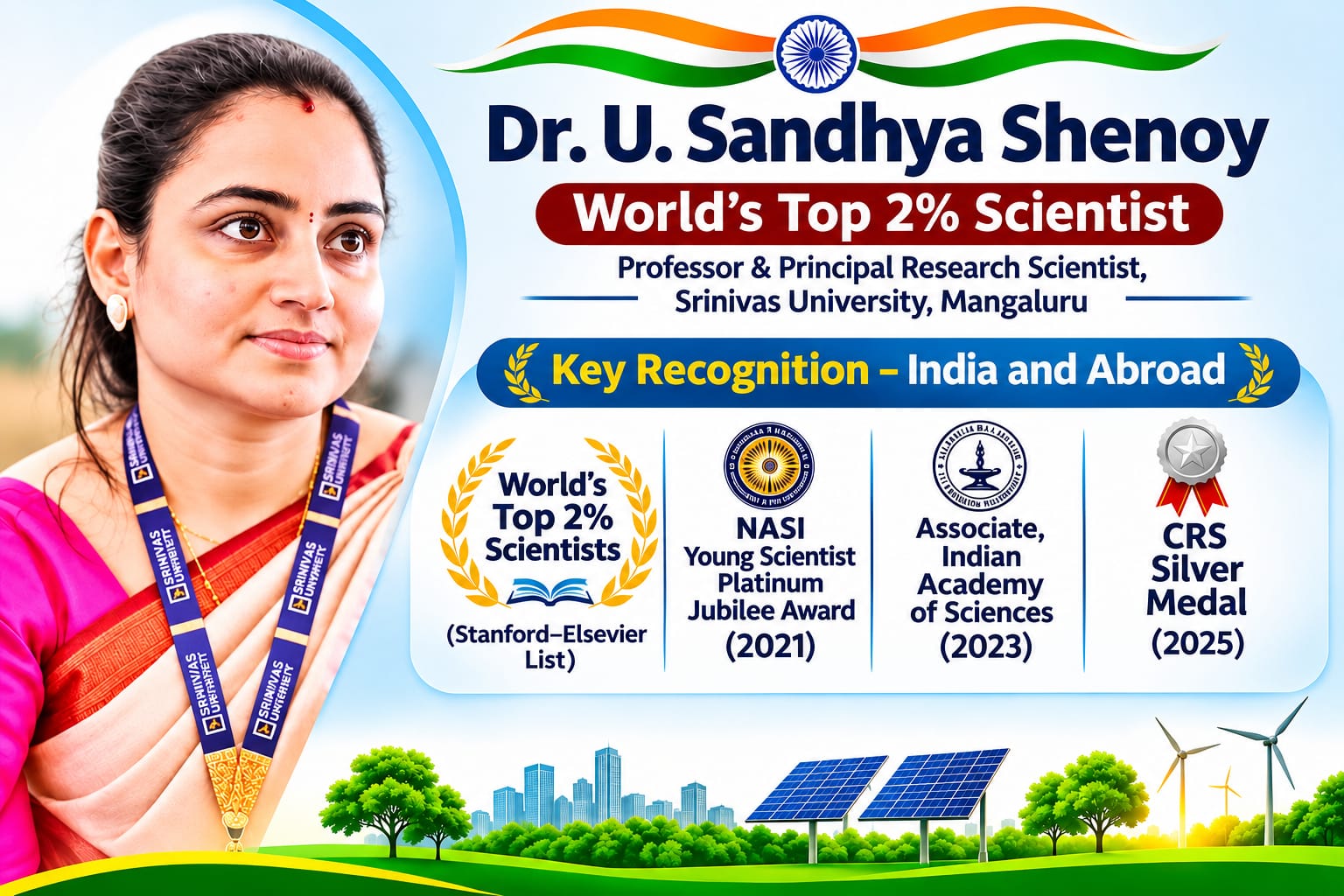
At a time when India is facing growing challenges related to energy demand, environmental pollution and water contamination, scientific research into advanced materials is opening new possibilities for sustainable development. Among the researchers working in this field is Dr. U. Sandhya Shenoy, Professor and Principal Research Scientist at the Department of Materials Science and Engineering, Srinivas University, Mangaluru.
Recognised in Stanford University and Elsevier’s World’s Top 2% Scientists list for three consecutive years (2023, 2024 and 2025), Dr. Shenoy has established a research profile in materials science, with particular emphasis on energy and environmental applications.
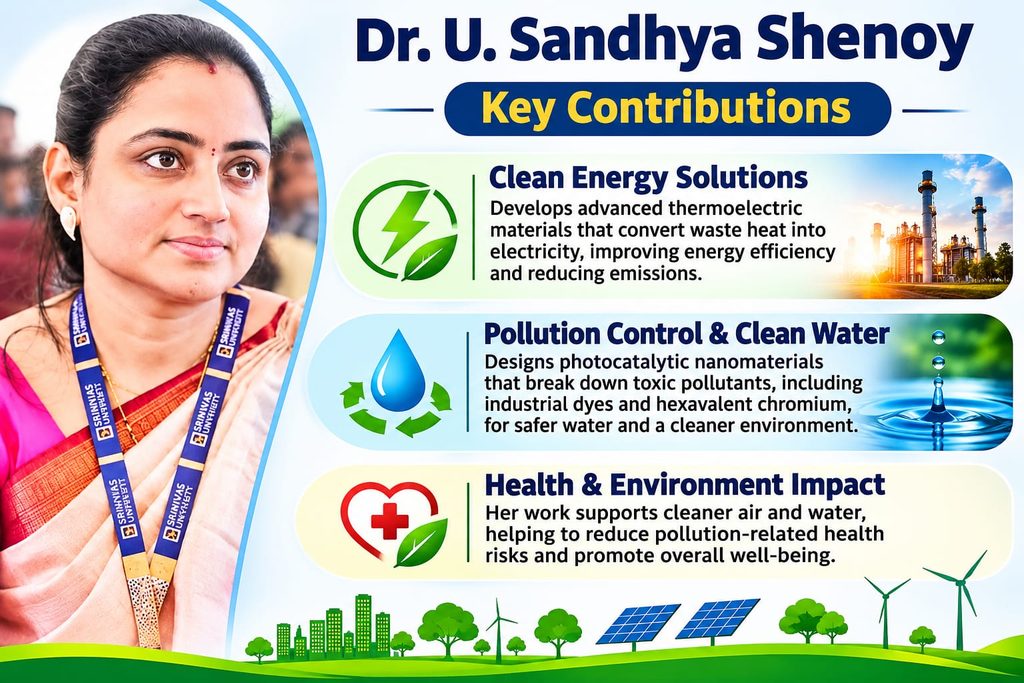
Her research explores how specially engineered materials can help recover otherwise wasted heat, improve energy efficiency and support the removal of certain environmental pollutants. These areas of research have potential applications in India’s transition towards cleaner energy and more sustainable environmental practices.
Converting Waste Heat into Electricity
One of the important areas of Dr. Shenoy’s research is the development of thermoelectric materials. These materials have the ability to convert temperature differences directly into electrical energy.
A significant amount of energy generated by industries, engines and other processes is lost in the form of heat. Thermoelectric technology offers a possible way to recover some of this otherwise wasted energy and convert it into useful electricity.
Dr. Shenoy’s research focuses on improving the performance of these materials through electronic structure engineering, material composition and nanostructuring.
If developed into commercially viable technologies, such materials could help industries improve energy efficiency, reduce energy wastage and make better use of available resources.
Nanotechnology for Environmental Protection
Another important dimension of her research involves photocatalysis, a process in which light activates specially designed materials to facilitate chemical reactions.
Photocatalytic materials are being investigated for their ability to break down certain organic pollutants, including industrial dyes present in wastewater.
Her research includes studies on engineered materials such as silver-doped barium titanate and graphene-based calcium titanate nanocomposites. Published research has reported promising results in the photocatalytic degradation of different dyes under laboratory conditions.
These developments could contribute to future wastewater treatment technologies and environmental remediation. However, their effectiveness, safety, cost and scalability need to be established before they can be considered practical large-scale treatment solutions.
Why Her Research Matters for Public Health
Environmental quality and public health are closely connected. Contaminated water, industrial discharge and inefficient energy use can create environmental conditions that affect communities.
Research into materials capable of supporting wastewater treatment and cleaner industrial processes therefore has potential public-health relevance.
Dr. Shenoy’s work is primarily in materials science rather than clinical medicine. Its significance for health lies in the possible environmental benefits of technologies developed through this research.
Cleaner water resources, reduced industrial pollution and improved energy efficiency can form part of a broader strategy for protecting public health and promoting sustainable development.
Academic Journey and Research Achievements
Dr. Sandhya Shenoy completed her MSc and PhD in Chemistry from the National Institute of Technology Karnataka (NITK), Surathkal, in 2009 and 2013, respectively.
She subsequently undertook postdoctoral research at the Jawaharlal Nehru Centre for Advanced Scientific Research (JNCASR), Bengaluru, under the supervision of Professor Umesh V. Waghmare.
In 2017, she joined Srinivas University as a DST INSPIRE Faculty Fellow. She was appointed as a SERB Research Scientist in 2022 and currently serves as Professor and Principal Research Scientist.
Her research interests include thermoelectric materials, photocatalysis, supercapacitors, nanomaterial synthesis, nanofluids and computational materials science.
Her recognitions include the NASI Young Scientist Platinum Jubilee Award in Chemical Sciences (2021), Associateship of the Indian Academy of Sciences (2023), Society for Materials Chemistry Bronze Medal (2024) and CRS Silver Medal (2025).
Advancing Science for a Sustainable Future
As India seeks solutions to its growing energy and environmental challenges, research in materials science and nanotechnology has an important role to play.
Dr. Sandhya Shenoy’s work represents an effort to connect fundamental scientific research with challenges that matter to society. From exploring ways to convert waste heat into electricity to developing materials for environmental remediation, her research highlights the possibilities offered by scientific innovation.
The next challenge will be translating promising laboratory findings into affordable, safe and scalable technologies that can benefit industries, communities and the environment.
(Series: The Real Hero)