
By Ekta Purohit /New Delhi: November 15, 2026
India records a major shift in healthcare financing as government investment rises nearly threefold and households’ direct healthcare spending share declines by 21.5 percentage points over a decade.
India has made significant progress towards affordable and accessible healthcare, with government spending on health increasing more than threefold over the past decade and the share of medical expenses paid directly by households declining substantially.
According to the National Health Accounts (NHA) Estimates 2023–24, released by the Union Ministry of Health and Family Welfare on November 15, 2026, Government Health Expenditure increased from ₹1.30 lakh crore in 2013–14 to ₹4.14 lakh crore in 2023–24.
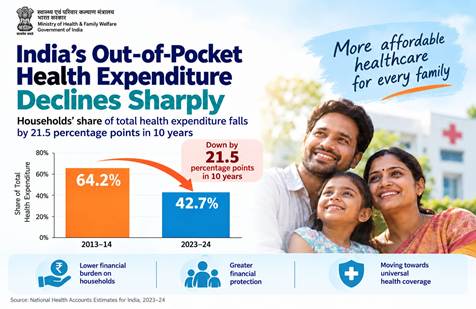
At the same time, the share of Out-of-Pocket Expenditure (OOPE) in Total Health Expenditure declined from 64.2% to 42.7%, marking a reduction of 21.5 percentage points.
The latest figures indicate a gradual shift towards greater public financing of healthcare and reduced dependence on direct household payments. These developments support India’s broader objective of achieving Universal Health Coverage.
Out-of-Pocket Healthcare Spending Declines to 42.7%
One of the most significant findings of the National Health Accounts report is the reduction in the financial burden directly borne by households.
The share of Out-of-Pocket Expenditure in total healthcare spending decreased from 64.2% in 2013–14 to 42.7% in 2023–24.
The decline continued during the latest reporting year, falling from 43.4% in 2022–23 to 42.7% in 2023–24.
This trend reflects the growing contribution of government-funded healthcare services, health insurance schemes and affordable treatment initiatives.
Government Health Expenditure Crosses ₹4 Lakh Crore
Public investment in healthcare has expanded significantly over the last ten years.
Government Health Expenditure increased from ₹1,29,778 crore in 2013–14 to ₹4,14,196 crore in 2023–24.
The government’s share in Total Health Expenditure also increased by 14.9 percentage points during this period, reflecting a stronger role for public resources in healthcare financing.
Per capita Government Health Expenditure nearly tripled, rising from ₹1,042 in 2013–14 to ₹2,959 in 2023–24.
This indicates a substantial increase in public healthcare spending per person.
Primary Healthcare Gets ₹1.53 Lakh Crore Investment
Strengthening primary healthcare has emerged as an important pillar of India’s healthcare strategy.
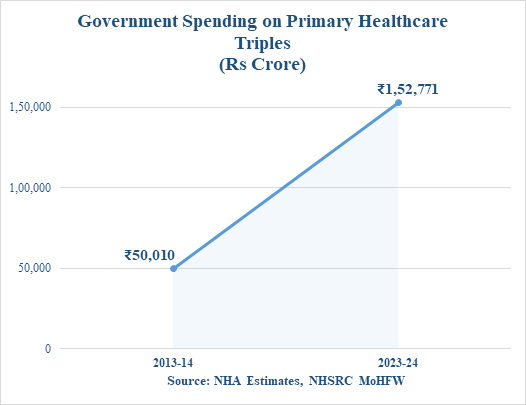
Government expenditure on primary healthcare reached approximately ₹1.53 lakh crore in 2023–24.
The investment supports the expansion of Ayushman Arogya Mandirs, which aim to bring essential healthcare services closer to communities.
These centres provide preventive and promotive healthcare, screening for non-communicable diseases, essential medicines, diagnostics and other primary healthcare services.
The focus on primary healthcare is expected to strengthen early disease detection and improve access to essential medical services, particularly at the grassroots level.
Social Security Spending on Healthcare Rises to 11%
The report also highlights an increase in social security financing for healthcare.
Its share in Total Health Expenditure increased from 6% in 2013–14 to 11% in 2023–24.
This includes government-financed health insurance programmes, state-specific health insurance schemes, social health insurance and medical expenditure for government employees.
Private health insurance expenditure also recorded significant growth, with its share rising from 3.4% to 10.2% during the same period.
These developments indicate an expanding role for insurance and other financial protection mechanisms in healthcare financing.
Ayushman Bharat, Jan Aushadhi and Free Treatment Initiatives Strengthen Healthcare Access
Several government initiatives are contributing to efforts to make healthcare more affordable and accessible.
Major programmes include:
- Ayushman Bharat – PM-JAY: Provides cashless hospitalisation coverage to eligible beneficiaries.
- Ayushman Arogya Mandirs: Expand comprehensive primary healthcare services at the community level.
- Pradhan Mantri Bhartiya Janaushadhi Pariyojana: Promotes access to quality generic medicines at affordable prices.
- Free Drugs and Diagnostics Initiatives: Support access to essential medicines and diagnostic services.
- Pradhan Mantri National Dialysis Programme: Improves access to dialysis services.
- AMRIT Pharmacies: Provide medicines and medical products at affordable prices.
- National Pharmaceutical Pricing Authority: Regulates prices of specified medicines and medical devices.
Together, these initiatives aim to reduce treatment costs, strengthen financial protection and improve healthcare accessibility.
India Moves Towards Universal Health Coverage
The National Health Accounts 2023–24 report highlights a decade of significant changes in India’s healthcare financing structure.
The increase in government healthcare expenditure, decline in household out-of-pocket spending and expansion of social security financing indicate a stronger public role in supporting healthcare delivery.
Under the leadership of Prime Minister Narendra Modi, the government has continued to emphasise affordable medicines, accessible primary healthcare, financial protection and expansion of healthcare infrastructure.
While challenges remain in ensuring equitable access and reducing the financial burden on every household, the latest estimates highlight important progress towards a more affordable and inclusive healthcare system.