

New Delhi : HL August 12, 2026
Hair porosity is an important part of understanding how your hair absorbs, retains and responds to moisture. It is mainly related to the condition and arrangement of the hair cuticle—the outermost layer of the hair shaft.
Knowing your hair’s porosity can help you choose suitable hair-care products, including oils, conditioners and moisturizing treatments. However, porosity is only one factor; hair thickness, texture, damage, chemical treatments and scalp condition also influence how a product performs.
What Is Hair Porosity?
Hair porosity describes how easily moisture can enter the hair shaft and how well the hair can retain that moisture.
Hair is commonly classified into three broad categories:
- Low Porosity Hair
- Medium Porosity Hair
- High Porosity Hair
No porosity type is inherently better or worse. The goal is to understand your hair and select products according to its needs.
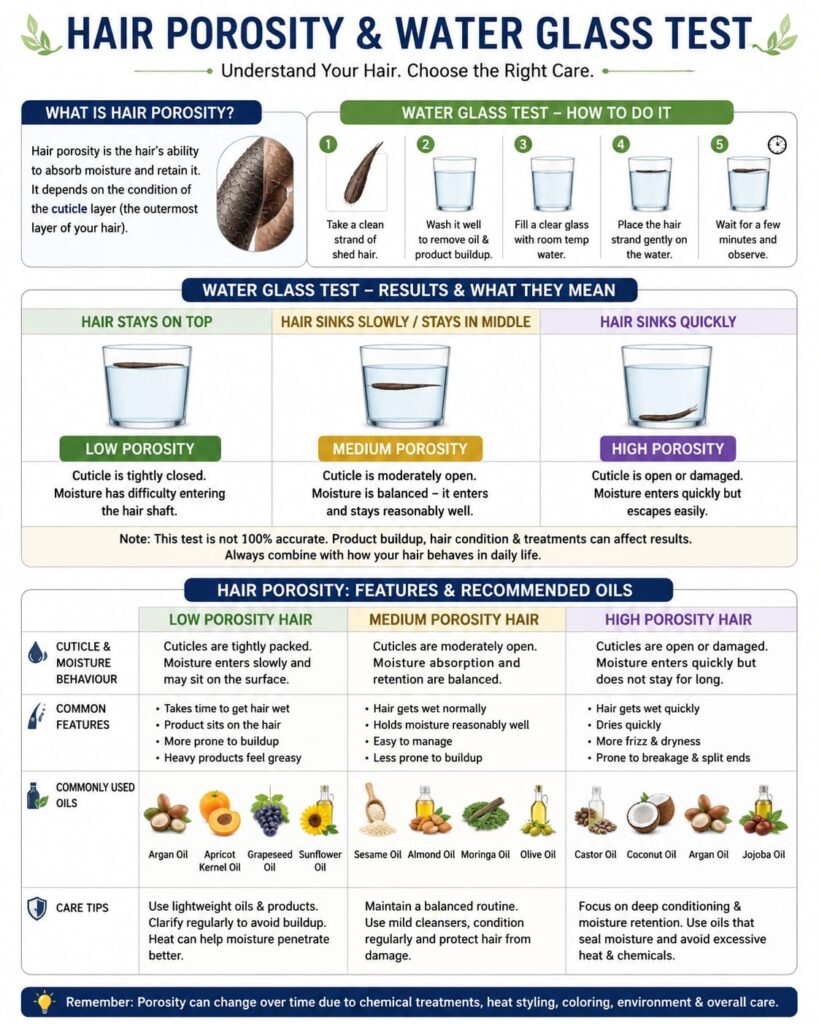
The oils shown in the comparison table are commonly used options, not strict prescriptions. The best routine is the one that suits your individual hair texture, condition and scalp needs.
Water Glass Test for Hair Porosity
The water glass test is a simple home method often used to get a rough idea of hair porosity. It is popular online, but it should not be considered a scientifically reliable diagnostic test because oil, conditioner, styling products and buildup can affect how a strand behaves in water.
How to Perform the Water Glass Test
- Take a few clean strands of shed hair.
- Wash them thoroughly to remove oil and styling-product residue.
- Fill a clear glass with room-temperature water.
- Place the hair strand gently on the surface of the water.
- Observe what happens over the next few minutes.
What the Results May Suggest
What the Hair Does What It May Suggest Common Interpretation
Stays floating on the surface Lower water absorption Low Porosity Hair
Slowly moves downward or remains around the middle Moderate water absorption Medium Porosity Hair
Sinks relatively quickly Higher water absorption High Porosity Hair
Important Limitation
A floating strand does not automatically mean low porosity, and a sinking strand does not necessarily prove high porosity. Hair surface condition, previous treatments and product residue can alter the result.
For a more useful assessment, combine the test with everyday observations such as how quickly your hair gets wet, how it responds to products, how long it takes to dry, and how well it retains moisture.
Quick Guide
Low Porosity → Moisture may take longer to enter → lightweight products may feel more comfortable.
Medium Porosity → Relatively balanced moisture behaviour → maintain a balanced routine.
High Porosity → Moisture may enter quickly but escape more easily → focus on conditioning and moisture retention.
- Low Porosity Hair
Low porosity hair generally has tightly packed cuticles. Water and moisturizing ingredients may take longer to penetrate the hair shaft. Products that are too heavy can sometimes sit on the surface and contribute to buildup.
Common signs
Hair may take time to become completely wet.
Products may remain on the surface.
Buildup can occur with excessive product use.
Heavy oils and creams may make hair feel greasy or flat.
Oils commonly used for low porosity hair
Argan oil, apricot kernel oil, grapeseed oil and sunflower oil are often chosen because they can provide conditioning without necessarily feeling as heavy as some thicker oils.
The amount used is important. Starting with a small quantity is generally preferable to applying a large amount.
- Medium Porosity Hair
Medium porosity hair is often considered relatively balanced in terms of moisture absorption and retention. The cuticle is neither extremely compact nor excessively open.
Common signs
Hair generally absorbs water without significant difficulty.
Moisture can be retained reasonably well.
Hair may be relatively easy to manage and style.
Excessive product buildup may be less common than with low porosity hair.
Oils commonly used for medium porosity hair
Sesame oil, almond oil, moringa oil and olive oil are commonly used in hair-care routines.
The best choice still depends on individual hair texture and how the hair responds to the particular oil.
- High Porosity Hair
High porosity hair may have more open or raised cuticles. This can occur naturally, but porosity can also increase following repeated bleaching, colouring, chemical treatments, excessive heat styling or other forms of damage.
High porosity hair may absorb moisture quickly but can have difficulty retaining it.
Common signs
Hair becomes wet quickly.
Hair may dry relatively quickly.
Frizz and dryness can be noticeable.
Split ends and breakage may occur.
Hair may benefit from regular conditioning and moisture-retention strategies.
Oils commonly used for high porosity hair
Castor oil, coconut oil, argan oil and jojoba oil are commonly incorporated into routines for high porosity hair.
Thicker oils such as castor oil may feel too heavy for some people, so individual response should be considered.
The right choice can depend on:
Hair thickness
Straight, wavy, curly or coily texture
Chemical processing
Heat damage
Scalp condition
Existing product buildup
Personal tolerance and preference
An oil may make one person’s hair soft and manageable while making another person’s hair greasy or weighed down.
Is the Water Glass Hair Porosity Test Accurate?
The popular water glass test, where a strand of hair is placed in water to see whether it sinks or floats, is widely shared online. However, it should not be treated as a definitive scientific test.
Oil, conditioner, styling products and buildup on the hair can affect how a strand behaves in water. It is better to consider several characteristics of your hair rather than relying on one home test.
How to Use Hair Oil According to Your Hair’s Needs
A simple approach is to begin with a small amount of oil and observe how your hair responds.
Apply a small quantity rather than saturating the hair.
Focus on the lengths and ends if they are dry.
Avoid excessive product layering.
Wash the hair according to your scalp and hair needs.
Use conditioner after shampooing when appropriate.
Stop using a product if it causes irritation or an unwanted reaction.
Can Hair Porosity Change?
Yes. Hair porosity is not necessarily fixed throughout life. Repeated bleaching, colouring, chemical straightening, heat styling and mechanical damage can alter the condition of the cuticle.
This means your hair-care routine may need to change as the condition of your hair changes.
Low porosity hair may respond better to lighter formulations, medium porosity hair often needs balanced care, while high porosity hair may require greater attention to conditioning and moisture retention.