
New Delhi: HL July 16, 2026
Drone technology could play a transformative role in India’s fight against tuberculosis by making diagnostic services faster, more affordable and accessible in remote regions, according to a new study conducted by the Indian Council of Medical Research (ICMR).
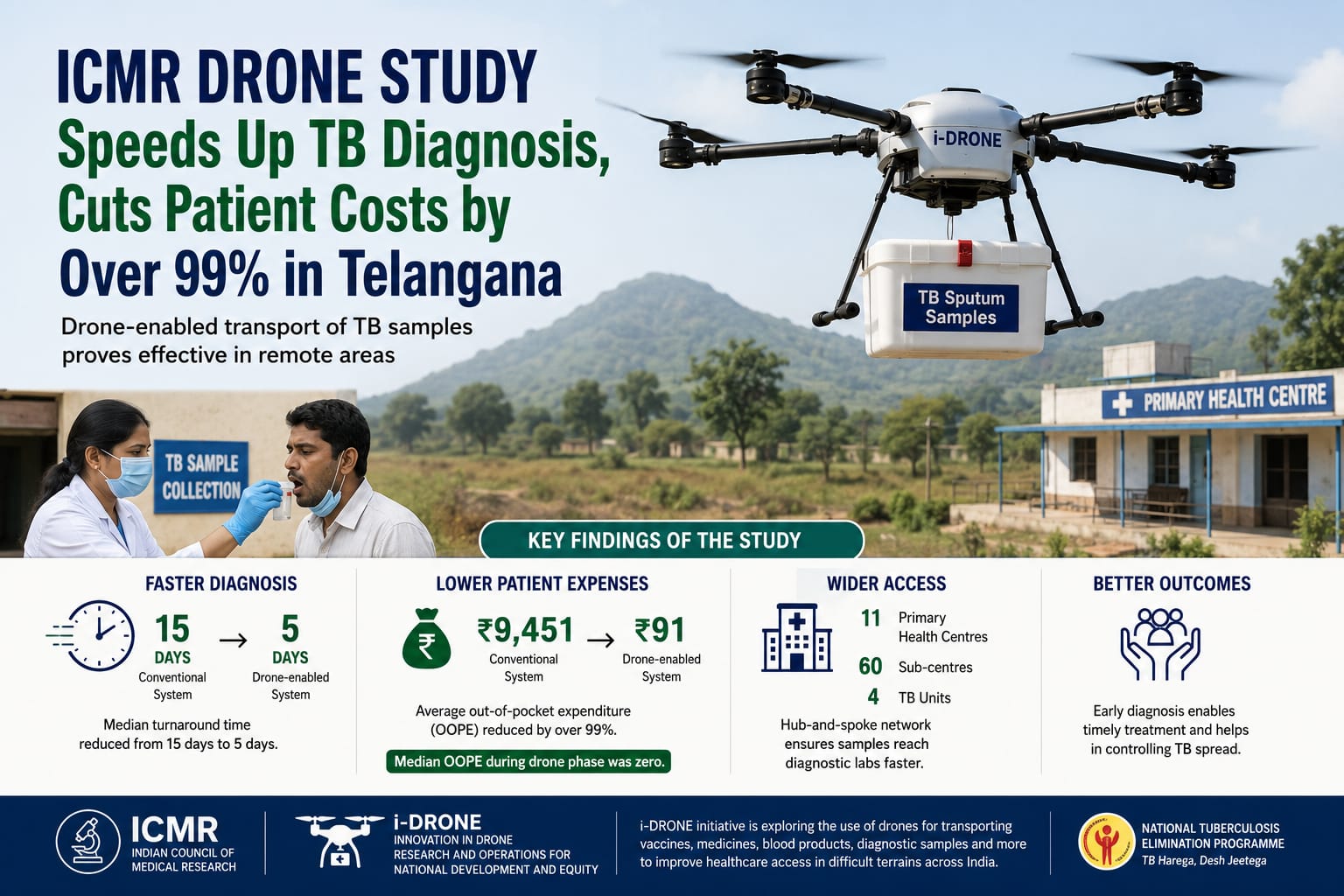
The research, carried out under the ICMR’s flagship i-DRONE initiative, evaluated the use of drones for transporting sputum samples from rural health centres to tuberculosis diagnostic laboratories in Telangana’s Yadadri-Bhuvanagiri district. The project was implemented in partnership with AIIMS Bibinagar and the District TB Office under the National TB Elimination Programme (NTEP).
The study involved 840 participants and compared the traditional system, where patients often travelled long distances for TB testing, with a drone-assisted model that allowed sputum samples to be collected at nearby Primary Health Centres and sub-centres before being flown to diagnostic facilities.
Researchers found that the median time required for TB diagnosis dropped dramatically from 15 days to just 5 days after drone-based transportation was introduced. Faster delivery of samples enabled earlier confirmation of infection and quicker initiation of treatment, an important factor in controlling disease transmission.
The financial impact on patients was equally significant. Under the conventional system, the average out-of-pocket expenditure (OOPE) for obtaining a TB diagnosis was approximately ₹9,451, reflecting travel expenses, wage losses and other associated costs. During the drone-based phase, this average fell to around ₹91, while the median expenditure dropped to zero, indicating that many patients no longer had to spend anything on travel for diagnostic testing.
The project established a hub-and-spoke network linking 11 Primary Health Centres, 60 sub-centres and four TB Units, enabling people in remote villages to submit samples closer to home rather than travelling to distant laboratories.
ICMR Director General and Secretary, Department of Health Research, Dr. Rajiv Bahl, said the findings demonstrate how innovative technologies can overcome geographical barriers in healthcare delivery. He noted that quicker diagnosis and lower patient expenses are critical to achieving India’s goal of eliminating tuberculosis.
Healthcare workers participating in the project also reported improved operational efficiency and positive community acceptance once people became familiar with the drone service. However, the researchers highlighted challenges including weather conditions, payload limitations and the need for continuous staff training, suggesting that careful planning will be essential before expanding the model to other regions.
Although the study was conducted in a single district, researchers believe it provides valuable operational evidence supporting the use of drone logistics in strengthening healthcare services in difficult-to-reach areas. Further studies across different geographical settings are expected to guide future public health planning.
The findings add to the growing body of evidence generated through the ICMR i-DRONE initiative, which is exploring the use of drones for transporting vaccines, medicines, blood products, diagnostic samples and other critical medical supplies to improve healthcare access across India.
Key Highlights
840 participants included in the study.
TB diagnosis time reduced from 15 days to 5 days.
Average patient expenses fell from ₹9,451 to about ₹91.
Median out-of-pocket expenditure became zero for many patients.
Drone network connected 11 PHCs, 60 sub-centres and 4 TB Units.
Study conducted in Yadadri-Bhuvanagiri district, Telangana.