
New Delhi: August 12, 2026
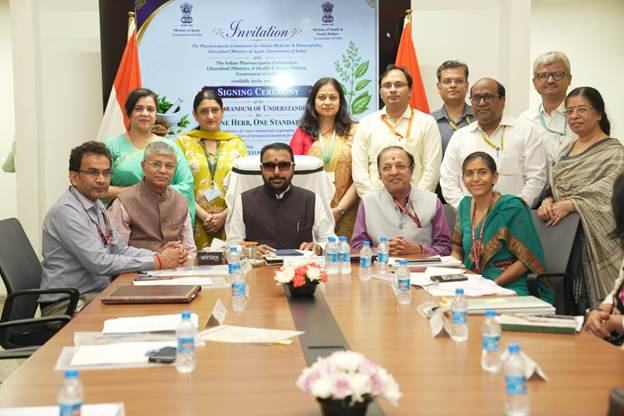
India has taken another significant step towards strengthening the quality, reliability and global credibility of traditional medicines with the renewal of a three-year Memorandum of Understanding (MoU) between the Pharmacopoeia Commission for Indian Medicine & Homoeopathy (PCIM&H), Ministry of Ayush, and the Indian Pharmacopoeia Commission (IPC), Ministry of Health & Family Welfare.
The renewed partnership will advance the “One Herb, One Standard” initiative, aimed at establishing common, scientifically robust quality standards for the same medicinal plants used across Ayurveda, Siddha, Sowa-Rigpa, Unani and Homoeopathy.
The MoU was exchanged by Dr. Kousthubha Upadhyaya, Director I/c, PCIM&H, and Dr. V. Kalaiselvan, Secretary-cum-Scientific Director, IPC, in the presence of Union Minister of State (Independent Charge), Ministry of Ayush and Minister of State, Ministry of Health & Family Welfare, Shri Prataprao Ganpatrao Jadhav, and Vaidya Rajesh Kotecha, Secretary, Ministry of Ayush, at Kartavya Bhavan, New Delhi.
Common Standards for Medicinal Plants
Addressing the gathering, Shri Prataprao Jadhav said that India’s traditional systems of medicine are an important part of the country’s knowledge traditions and rich medicinal plant heritage. He stressed that scientifically developed standards for quality, purity and standardisation are essential for enhancing the credibility of traditional medicines.
The Minister said the “One Herb, One Standard” approach will create a common and reliable standard for medicinal plants used across different systems. Such harmonisation is expected to reduce ambiguity among manufacturers, laboratories, regulators and other stakeholders while creating a more coordinated standardisation framework.
50 Monographs Developed During First Phase
The renewed cooperation builds on the MoU initiated in 2022. During the first phase, 50 monographs of medicinal plants were successfully developed.
The next three-year phase will expand this work by developing additional harmonised standards for plant-based single drugs. The monographs will consider both Indian standards and international quality requirements, with the objective of aligning Indian quality benchmarks with global expectations.
Boost to Quality and Ease of Doing Business
According to Shri Jadhav, harmonised standards can make regulatory and quality-related processes more streamlined and transparent. This could benefit manufacturers, exporters, testing laboratories, regulatory institutions and other stakeholders involved in the traditional medicine sector.
Stronger standards could also support the wider international acceptance of Indian medicinal plants and traditional medicine products by providing clearer and more consistent quality benchmarks.
Strengthening India’s Global Position
The initiative is expected to combine the scientific and standard-setting expertise of PCIM&H and IPC to strengthen quality assurance across traditional systems of medicine.
The collaboration also underlines India’s efforts to protect its rich biodiversity and traditional medicinal heritage while developing globally credible standards for medicinal plants and traditional medicines.
The renewed MoU reaffirms the commitment of both institutions to scientific excellence, quality, reliability and international acceptance of India’s traditional medicine systems through a harmonised approach to botanical standardisation.