
New Delhi: HL September 15, 2026
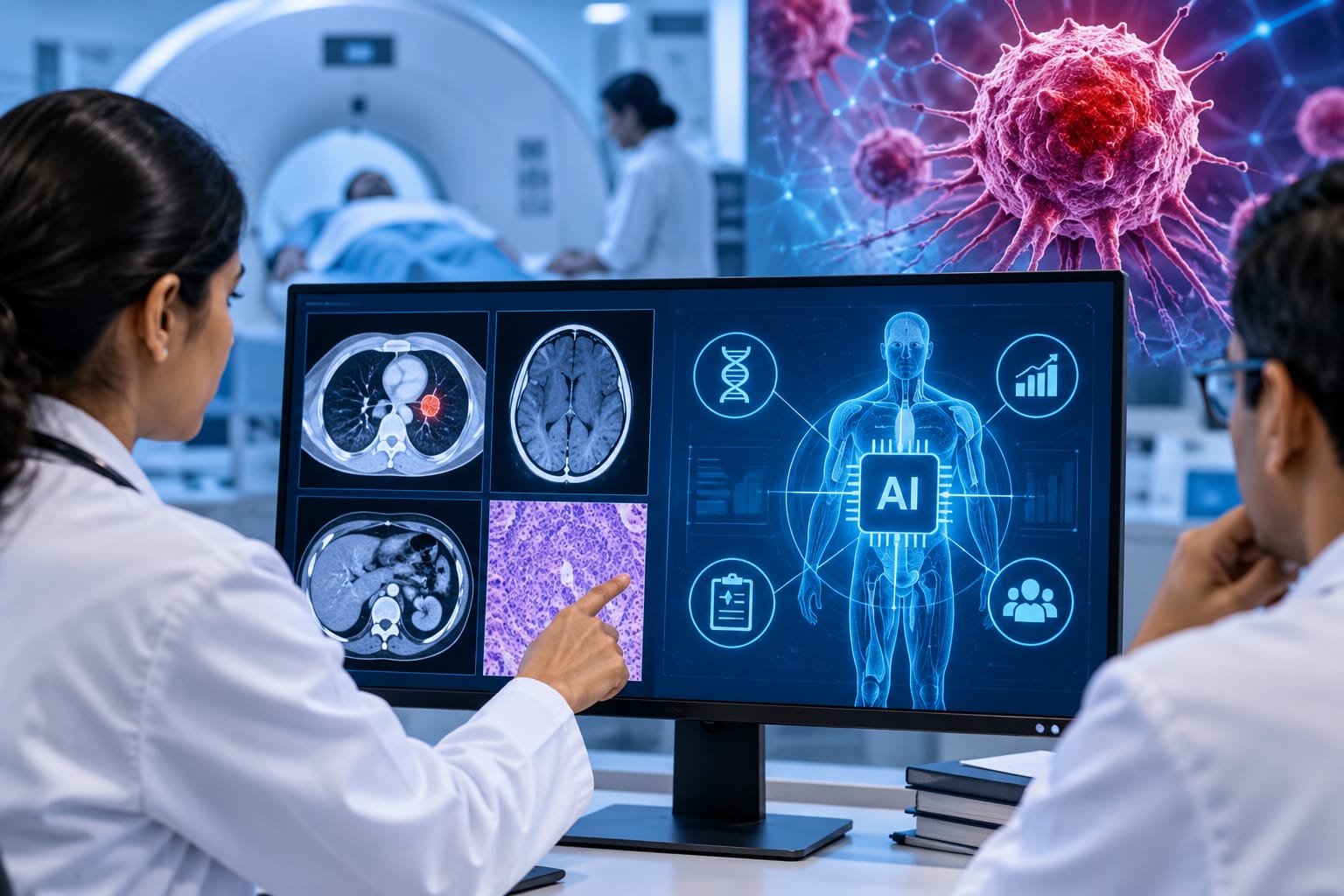
Artificial Intelligence (AI) is increasingly emerging as an important tool in cancer care, with applications ranging from early detection and risk assessment to treatment planning and patient monitoring. In a significant step towards technology-enabled cancer management, AIIMS New Delhi and the Centre for Development of Advanced Computing (C-DAC), Pune have developed an ‘AI Oncology’ platform aimed at supporting doctors in analysing complex cancer-related information.
The platform seeks to bring together different categories of medical data and use AI and machine-learning capabilities to assist healthcare professionals in making more informed clinical decisions.
Integrating Multiple Sources of Cancer Data
Cancer patients generate large volumes of medical information during diagnosis and treatment. This may include clinical records, radiological images, histopathological findings and other health-related information.
The AI Oncology initiative focuses on integrating such diverse datasets to provide doctors with a more comprehensive view of a patient’s condition. The technology could potentially help identify patterns that may be difficult to assess manually when large volumes of information are involved.
The platform is also being developed with the objective of incorporating additional patient-related information and research data in the future.
AI Could Strengthen Cancer Screening and Treatment Planning
One of the major potential applications of AI in oncology is supporting doctors during the early stages of cancer detection. AI-based analysis can assist healthcare professionals in evaluating medical images and other diagnostic information.
Beyond screening, such systems could support risk assessment, treatment-related decision-making and follow-up care. By bringing relevant patient information together, AI could help clinicians evaluate cases more systematically.
However, AI-based systems are intended to support—not replace—medical professionals. Final diagnosis and treatment decisions require clinical expertise, appropriate testing and professional medical judgement.
Digital Health Integration
The AI Oncology platform has also been designed with the broader digital-health ecosystem in mind. Integration with electronic health records and digital health infrastructure could eventually make it easier to use relevant patient information across different stages of healthcare.
Such interoperability could be particularly valuable for patients who undergo multiple diagnostic tests and treatment procedures at different healthcare facilities.
India Faces a Growing Cancer Burden
The development of advanced technologies comes at a time when cancer is becoming an increasingly significant public-health challenge in India.
According to figures cited in the report, India recorded approximately 15.62 lakh new cancer cases and 9.01 lakh cancer-related deaths in 2024. The projected annual number of new cases could rise to more than 23 lakh by 2040, highlighting the need for stronger prevention, early detection, diagnosis and treatment systems.
Breast cancer remains among the major cancer concerns, particularly among women, while several other cancers continue to contribute substantially to the country’s overall disease burden.
Potential Relevance for BRICS Countries
The increasing cancer burden is a challenge shared by several countries. With millions of new cases being reported annually across BRICS nations and other countries, affordable and scalable digital-health solutions could become increasingly important.
An AI-based oncology platform, if validated through rigorous clinical research and implemented with appropriate safeguards, could potentially support healthcare systems dealing with large patient volumes.
Key Potential Benefits of AI Oncology
Early cancer detection support
Analysis of medical and imaging data
Cancer risk assessment
Assistance in treatment planning
Integration of clinical and pathology information
Digital patient-record management
Support for research and clinical decision-making
Potential scalability across healthcare systems
The Road Ahead
AI is unlikely to replace oncologists, radiologists, pathologists or other healthcare professionals. Its greater potential lies in helping specialists process large and complex datasets more efficiently.
For AI Oncology platforms to become part of routine cancer care, they will need extensive clinical validation, reliable datasets, strong data-protection mechanisms and continuous monitoring for accuracy and bias.
The AIIMS-C-DAC initiative represents a step towards combining India’s growing capabilities in healthcare, artificial intelligence and digital technology to address one of the country’s major public-health challenges.