
New Delhi : HL September 16, 2026
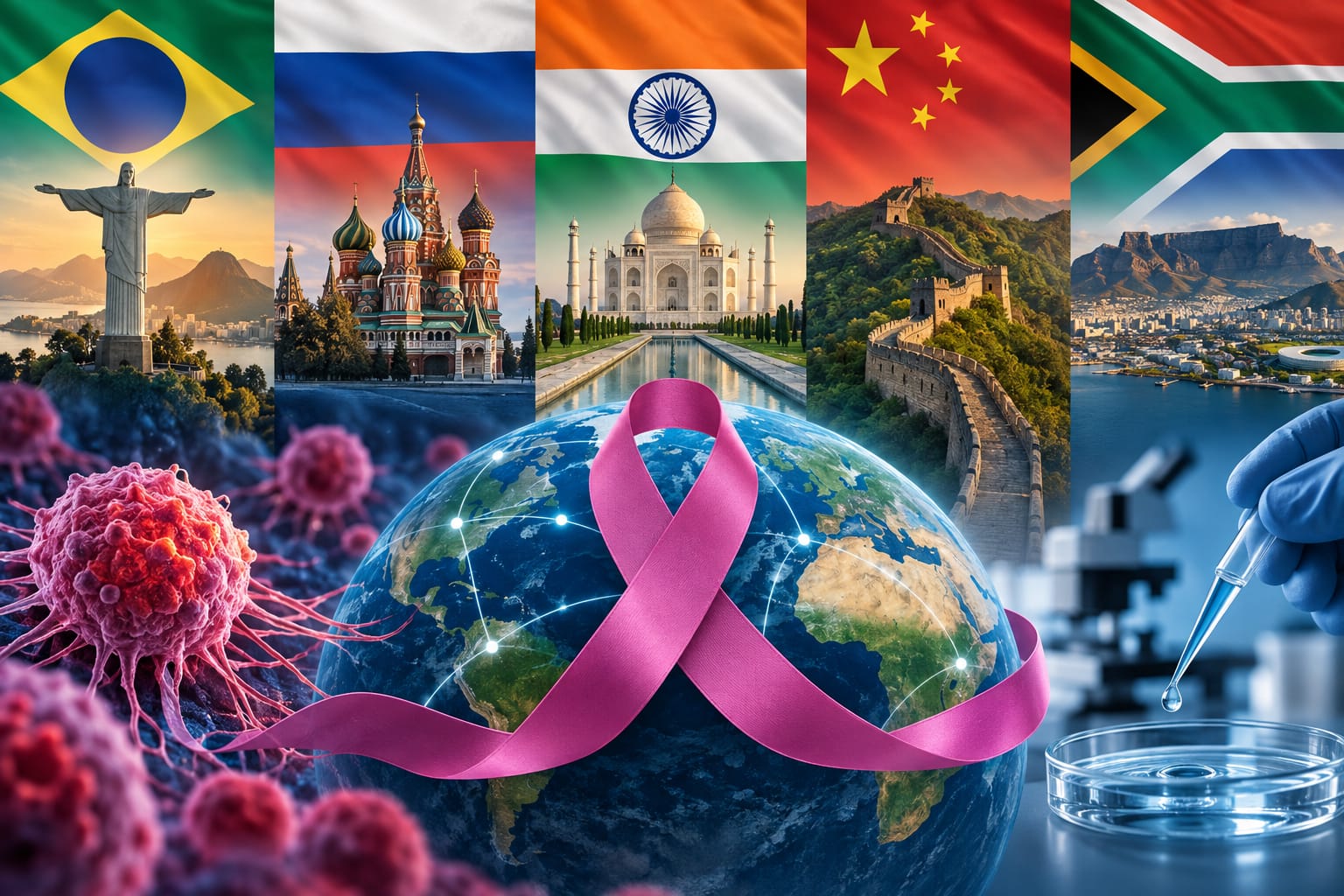
Cancer is becoming an increasingly important health challenge across the BRICS economies. The latest GLOBOCAN 2024 estimates from the International Agency for Research on Cancer (IARC) recorded 20.6 million new cancer cases and 9.8 million cancer deaths worldwide in 2024.
For BRICS, the scale of the problem is particularly significant because the group contains some of the world’s most populous countries.
BRICS cancer ranking: what the comparable data show
For the original five BRICS countries — China, India, Russia, Brazil and South Africa — the latest directly comparable country-level ranking published from GLOBOCAN data shows:
Rank| Country| New cases, 2022| Cancer deaths, 2022
1| China| 4,824,703| 2,574,176
2| India| 1,413,316| 916,827
3| Russia| 635,560| 311,729
4| Brazil| 627,193| 278,835
5| South Africa| 111,321| 64,547
These figures come from GLOBOCAN 2022 and remain useful for a country-to-country numerical comparison; the newer GLOBOCAN 2024 dataset is now the latest global reference.
Ranking by cancer incidence rate
Simply ranking countries by the number of cases can be misleading because population sizes are very different.
Among the original five BRICS countries, the GLOBOCAN 2022 analysis found Russia had the highest age-standardised incidence rate (ASIR) at 248.1 cases per 100,000 people, followed by Brazil at 214.4 and South Africa at 203.4.
This is an important distinction:
China and India have the largest numbers of cancer cases, but Russia had the highest age-standardised incidence rate among the five.
Ranking by cancer mortality rate
The picture changes when mortality is adjusted for population age structure.
South Africa recorded the highest age-standardised mortality rate (ASMR) among the original five BRICS countries, at 122.5 deaths per 100,000 people. Russia followed among the countries analysed, while Russia had the highest ASMR among men at 153.0 per 100,000.
This demonstrates why case numbers alone cannot be used to judge the severity of a country’s cancer problem.
China: largest absolute cancer burden
China recorded approximately 4.8 million new cancer cases and 2.57 million cancer deaths in 2022, making it the largest cancer burden among the original BRICS members in absolute numbers.
Lung cancer is particularly important. In the GLOBOCAN 2022 analysis, lung cancer accounted for approximately 733,291 deaths in China, far more than any other cancer type.
India: second-largest burden, but a different cancer profile
India recorded approximately 1.41 million new cases and 916,827 cancer deaths in 2022.
India’s cancer profile differs from China’s. In the comparative BRICS analysis, breast cancer was the leading cause of cancer death in India, while cancers of the lip and oral cavity were particularly prominent among incidence patterns. Cervical cancer also remains an important concern.
Russia: highest incidence rate among the original BRICS five
Russia had the highest age-standardised incidence rate among the five original BRICS countries at 248.1 per 100,000. It recorded about 635,560 new cases and 311,729 cancer deaths in 2022.
Brazil
Brazil recorded approximately 627,193 new cancer cases and 278,835 deaths in 2022. Lung cancer was the largest contributor to cancer deaths in the comparative BRICS analysis, followed by colorectal cancer.
South Africa: highest mortality rate
South Africa had the smallest absolute number of cases among the original five, with approximately 111,321 new cases and 64,547 deaths in 2022. However, its age-standardised mortality rate was the highest among the five, at 122.5 per 100,000.
That difference between absolute numbers and mortality rates is particularly important when comparing countries with very different population sizes and healthcare systems.
What does the latest global data say?
The newest GLOBOCAN 2024 estimates show that cancer remains a major global challenge. Worldwide, lung cancer was the most commonly diagnosed cancer in 2024, with approximately 2.64 million new cases and 1.86 million deaths. Breast cancer ranked second in incidence, while colorectal cancer ranked third.
IARC projects that annual global cancer cases could reach 34.4 million by 2050, about 67% higher than the 2024 level, largely because of population growth and ageing.
The key takeaway
The BRICS cancer picture cannot be reduced to a simple “worst-to-best” ranking.
– China has the largest absolute number of cases and deaths among the original BRICS countries.
– India has the second-largest absolute burden.
– Russia recorded the highest age-standardised incidence rate among the five.
– South Africa recorded the highest age-standardised mortality rate.
– Brazil has a substantial burden, particularly from lung and colorectal cancers.
These differences point to different priorities for cancer control: prevention, tobacco control, vaccination, screening, early diagnosis, affordable treatment and improved access to oncology services.
The latest data therefore show that the BRICS cancer challenge is not simply about discovering new cancer cures. It is also about detecting cancer earlier and ensuring that effective treatment reaches patients regardless of where they live or their ability to pay.