
New Delhi: HL September 24, 2026
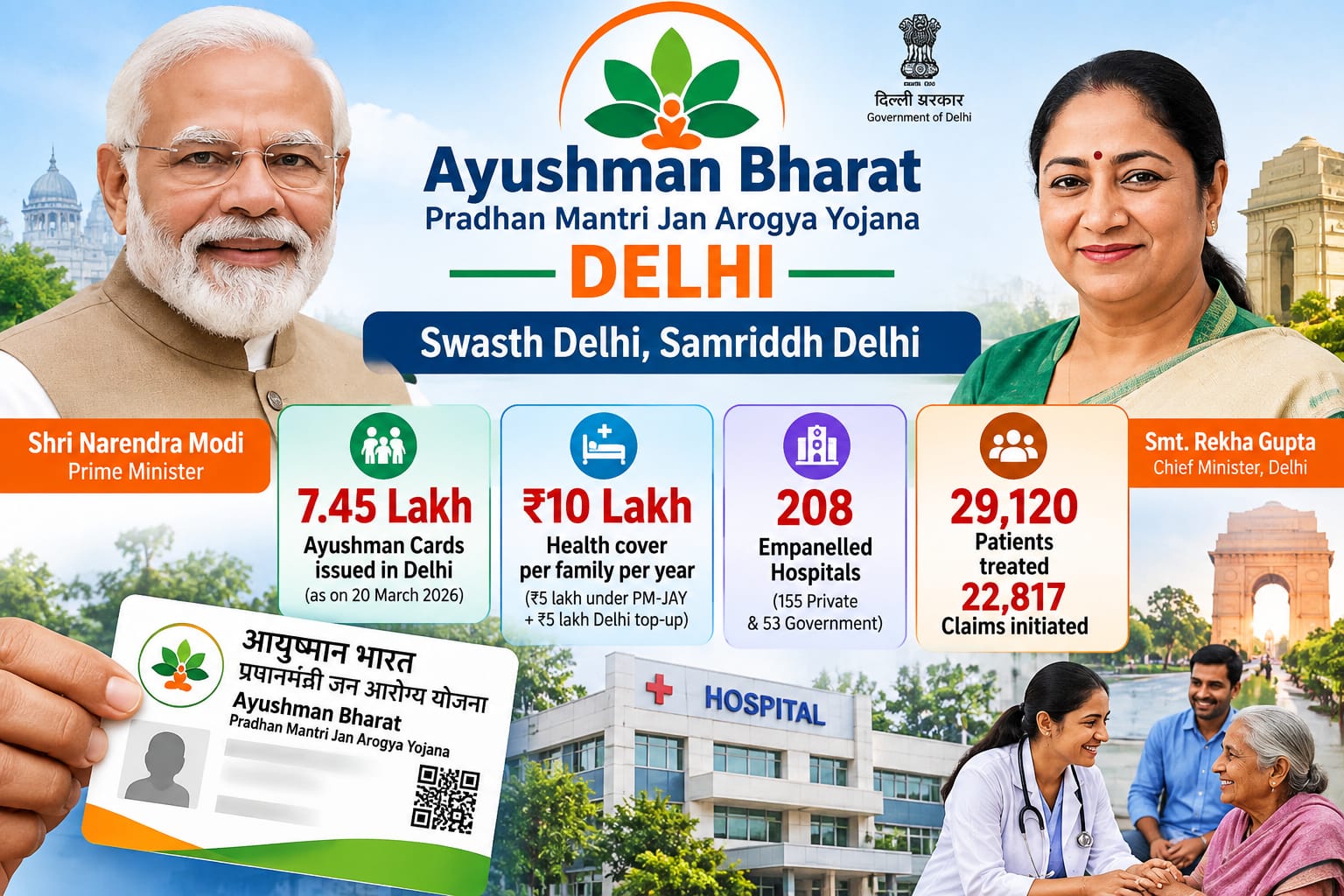
The Ayushman Bharat–Pradhan Mantri Jan Arogya Yojana (AB-PMJAY) has expanded its reach in Delhi, with 7,45,631 Ayushman Cards issued as of March 20, 2026, according to figures cited in the Delhi Economic Survey 2025–26.
The scheme, which was implemented in Delhi from April 5, 2025, provides eligible beneficiaries with health coverage of up to 5 lakh per family per year under PM-JAY. The Delhi government has also approved an additional 5 lakh top-up, taking the potential annual health cover for eligible families to 10 lakh. The implementation of PM-JAY in Delhi was formally approved by the Delhi government in February 2025.
As per the Economic Survey data, 208 hospitals had been empanelled under PM-JAY in Delhi by March 20, 2026. These included 155 private and 53 government hospitals. During the period, 29,120 patients received treatment, while the payment process for 22,817 claims had been initiated.
The expansion of the scheme has also been reflected in the Delhi government’s 2026–27 Budget, which states that coverage has been widened to include groups such as ASHA workers, Anganwadi workers, widows and disability pension holders, with the overall beneficiary coverage projected at around 7.5 lakh.
At the national level, PM-JAY continues to provide cashless hospitalisation coverage through a large network of public and private hospitals. As of June 30, 2026, more than 12.69 crore hospital admissions had been authorised nationally under the scheme, according to the Union Health Ministry.
The Delhi figures indicate the scale of PM-JAY’s implementation in the capital during its initial phase, while further expansion of beneficiary coverage and the empanelled hospital network could increase access to cashless healthcare services.