

New Delhi |HL, 27 October
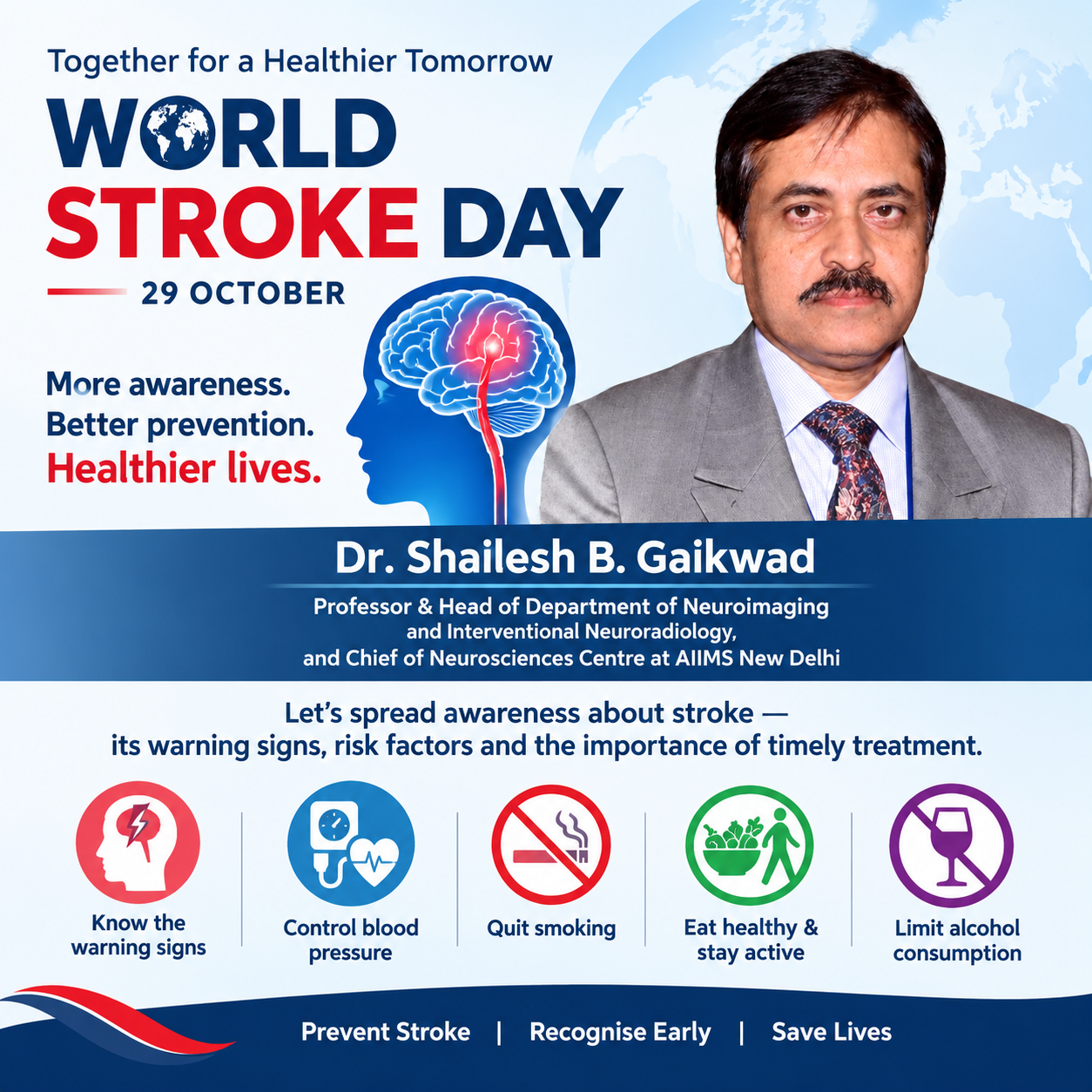
With around 18 lakh stroke cases recorded across India each year, awareness can save lives. On the occasion of World Stroke Day, observed on October 29, Ms. Ekta spoke with Dr. Shailesh B. Gaikwad of AIIMS to discuss what causes a stroke, which symptoms demand immediate attention, and the steps we can take to prevent it.
Act Immediately—Call an Ambulance, Note the Time, and Reach a Stroke-Ready Hospital
Major causes of stroke or brain attack?
Stroke is a serious neurological emergency in which the blood supply to part of the brain is interrupted or a blood vessel in the brain ruptures. There are two major types of stroke: ischemic stroke, in which a blood clot blocks a blood vessel in the brain, and hemorrhagic stroke, in which a ruptured blood vessel causes bleeding in the brain.
High blood pressure is one of the leading risk factors for stroke. Other factors include diabetes, high cholesterol, certain heart conditions—particularly atrial fibrillation—smoking, excessive alcohol consumption, obesity, physical inactivity, and an unhealthy diet. The risk increases with age, but stroke can occur at any age. Regular health check-ups and proper control of these risk factors can reduce the risk in many cases.
How can an ordinary person recognize a stroke
The FAST principle can help identify a stroke quickly:
F – Face: Does one side of the face droop when the person smiles?
A – Arm: Has sudden weakness or numbness developed in one arm or leg?
S – Speech: Is the person having difficulty speaking, understanding words, or speaking clearly?
T – Time: Call an ambulance immediately. Do not wait to see whether the symptoms improve.
Sudden loss or blurring of vision, double vision, loss of balance, difficulty walking, or an extremely severe headache without an obvious cause may also indicate a stroke.
The moment any symptom begins, record the exact time. If the person was last seen well, record that time as well. This information is essential because some emergency treatments are time-dependent. Even if the symptoms disappear within a few minutes, call an ambulance and seek urgent medical care, as this may be a transient ischemic attack (TIA), which can warn of a major stroke.
Do not allow the patient to drive. Activate emergency ambulance services immediately and request transport to a stroke-ready hospital. Do not give aspirin, blood thinners, food, water, or any other medication unless specifically advised by a medical professional. Some strokes are caused by bleeding, and self-medication can worsen the condition. Keep the patient safe, note the symptoms and their onset time, and share the patient’s medical history and current medications with the emergency team.
Treatment and preventive measures for stroke
Stroke treatment begins with immediate emergency action. Call an ambulance as soon as symptoms appear, record the symptom onset time, and ensure rapid transport to a stroke-ready hospital. Ambulance transport is preferable to private travel because emergency teams can provide initial care, alert the hospital, and help reduce delays after arrival.
At the hospital, urgent CT or MRI of the brain, along with appropriate blood-vessel imaging, is performed to determine whether the stroke is caused by a blockage or bleeding. The treatment differs substantially between these conditions. Families should not delay transport while arranging home remedies, consulting multiple people, or waiting for symptoms to improve.
Selected patients with ischemic stroke may receive clot-dissolving medication through a vein, depending on the time window and medical eligibility criteria. In suitable patients, this treatment is generally administered within four and a half hours of symptom onset. In some cases, advanced imaging may show that treatment could still be beneficial beyond this period. If a major blood vessel is blocked, mechanical thrombectomy may remove the clot through a catheter-based procedure. In selected patients, this may be beneficial up to 24 hours after symptom onset, depending on imaging and other clinical criteria.
If the stroke is caused by bleeding, treatment may include careful blood-pressure control, reversal of blood-thinning medication when appropriate, treatment of the underlying cause, and neurosurgery or endovascular treatment when necessary. This is why aspirin or any other medication must not be given without medical advice before brain imaging.
After the emergency phase, physiotherapy, speech therapy, occupational therapy, and rehabilitation are important for recovery. Prevention includes controlling blood pressure, diabetes, and cholesterol; quitting smoking; limiting alcohol; exercising regularly; following a balanced diet; maintaining a healthy weight; getting adequate sleep; and receiving appropriate treatment for heart disease. People who have had a stroke or TIA should take preventive medicines only as prescribed and attend regular follow-up appointments.
New technologies or surgeries for stroke treatment
Over the past few years, interventional neuroradiology and neurointervention have made significant advances in stroke treatment. These treatments are available only at appropriately equipped hospitals and are most effective when patients arrive quickly.
Mechanical thrombectomy is an important technique in which a catheter is guided through a blood vessel, without opening the skull, to remove a clot lodged in a major blood vessel of the brain. In appropriately selected patients, it can reduce disability and improve the chances of independent living.
Advanced CT/MRI and blood-vessel imaging help doctors determine which brain tissue is severely damaged and which tissue may still be saved. This supports treatment decisions in selected patients, including those who arrive later than the usual treatment window. In certain situations, decompressive surgery may be performed to reduce dangerous brain swelling and pressure. If bleeding results from a ruptured aneurysm, coiling or other endovascular techniques may be used.
Future advances—including artificial intelligence-assisted stroke detection, improved imaging, mobile stroke units, faster ambulance-based triage, telestroke services, and stronger networks of stroke-ready hospitals—may further improve access and outcomes. However, these advances can help only when the public recognizes the symptoms, calls an ambulance immediately, records the exact onset time, avoids self-medication, and reaches a hospital capable of providing urgent stroke care.
Remember if STROKE happens
Stroke is an emergency. Remember FAST, call an ambulance immediately, note the exact time symptoms began, do not give medicines without medical advice, and seek care at the nearest stroke-ready hospital. Every minute matters, and one timely action can save a life and reduce permanent disability.