

New Delhi: HL August 08, 2026
At a time when Delhi’s major government hospitals are witnessing mounting pressure on their existing infrastructure, two major hospital expansion projects have raised serious questions over the pace of healthcare infrastructure development and the seriousness with which such projects are being monitored.
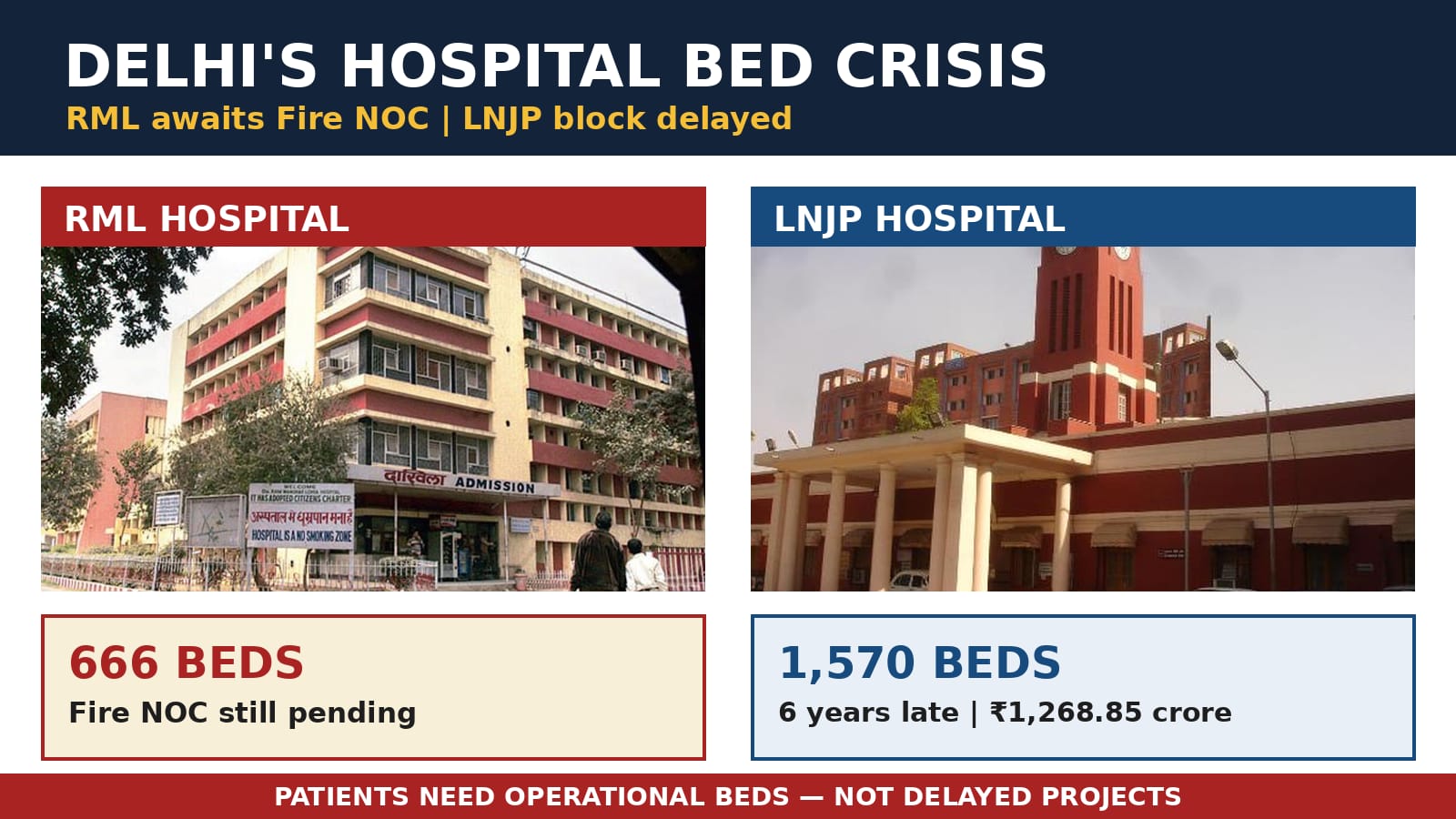
The 1,570-bed expansion block at Lok Nayak Jai Prakash (LNJP) Hospital is running nearly six years behind its original schedule, while its estimated cost has shot up from ₹533.91 crore to ₹1,268.85 crore. At Dr Ram Manohar Lohia (RML) Hospital, meanwhile, the much-awaited 666-bed Super Speciality Block is still awaiting a Fire Safety Certificate, with the Delhi High Court directing the Central Public Works Department (CPWD) to rectify 20 identified fire-safety deficiencies.
Together, the two cases raise a larger and uncomfortable question: when Delhi’s public hospitals are already under pressure from increasing patient footfall, why are thousands of additional beds and specialised facilities still not available to patients?
Thousands of Beds Planned, But Patients Are Still Waiting
The numbers are significant–
The new LNJP block is expected to add 1,570 beds to the hospital’s capacity. The project was initially approved in 2019 for ₹533.91 crore, with construction beginning in 2020 and completion originally scheduled for May 2023.
Yet, according to the project details, only around 55% of the work has been completed.
More than ₹586 crore has already been spent, while another ₹682.75 crore is reportedly required for the remaining work. The revised project cost has consequently risen to ₹1,268.85 crore.
In other words, a project originally planned for ₹533.91 crore now carries a price tag more than two times the initial estimate, while patients are still waiting for the promised additional capacity.
The question is not merely about cost—it is about lost healthcare capacity
Every year of delay means another year in which the additional beds, operating facilities and medical infrastructure planned under the project remain unavailable to patients.
For a government hospital catering to a huge number of patients, such delays cannot be viewed merely as an administrative inconvenience.
A delayed hospital bed is ultimately a delayed healthcare facility for a patient–
RML’s 666-Bed Super Speciality Block Has a Different Problem
The situation at RML Hospital presents another concern.
The hospital’s Super Speciality Block, reportedly built at a cost of around ₹400 crore, has approximately 666 beds, along with specialised medical infrastructure and modern operation theatres.
But the facility has not yet become fully operational because the required Fire Safety Certificate remains pending.
According to the submissions before the Delhi High Court, the Delhi Fire Service rejected the Fire Safety Certificate application on March 9, 2026, after identifying 20 fire-safety deficiencies.
A subsequent inspection took place on July 4, but the deficiencies reportedly remained unresolved. The application was again rejected on July 22.
The Delhi High Court has now directed CPWD to take prompt steps to rectify the deficiencies and complete the necessary compliance.
Why Were the Deficiencies Not Fixed Earlier?
Fire safety is not an optional formality for a hospital. A large healthcare facility housing critically ill patients, elderly people, patients with limited mobility and those dependent on medical equipment cannot be opened without proper safety clearance.
But the obvious question remains:
If 20 fire-safety deficiencies were identified in March, why were they still unresolved by the July inspection?
And if the deficiencies were known, why did it require judicial intervention for the matter to receive urgent attention?
The objective should not simply be to obtain a Fire NOC after repeated inspections. The larger responsibility is to ensure that safety requirements are incorporated, checked and completed before a major public hospital project reaches this stage.
Two Projects, One Larger Question
The LNJP and RML cases are different, but they point towards the same broader concern: the gap between creating healthcare infrastructure on paper and actually making it available to patients.
At LNJP, a 1,570-bed block is facing a prolonged construction delay and a massive cost escalation.
At RML, hundreds of planned beds and specialised services remain unavailable because the facility is awaiting fire-safety clearance.
For patients, however, the distinction between construction delay, administrative delay, contractor-related issues or statutory clearance is largely irrelevant.
They simply need a bed, treatment and timely medical care.
Where Is the Accountability for Delays?
The LNJP project has already attracted serious scrutiny from the Expenditure Finance Committee, which has sought a detailed report and directed a vigilance inquiry into the decision-making process. The committee has also asked for responsibility to be fixed if irregularities are found.
That raises another fundamental question:
Who is accountable when a ₹533.91-crore project becomes a ₹1,268.85-crore project and is still incomplete?
Similarly, at RML, if fire-safety deficiencies were identified months ago, which agency was responsible for ensuring that they were rectified within the shortest possible time?
Was there adequate coordination between the hospital administration, Health Department, CPWD and fire authorities?
Were the deficiencies monitored through a time-bound mechanism?
Were senior officials reviewing the progress regularly?
And most importantly, did the urgency match the needs of patients waiting for these additional facilities?
Delhi’s Growing Patient Burden Cannot Wait
Delhi’s major government hospitals serve not only residents of the national capital but also patients arriving from neighbouring states.
Facilities such as LNJP and RML therefore operate under enormous pressure. When existing infrastructure is stretched, every additional operational bed becomes important.
The delay in commissioning new capacity can translate into:
Greater pressure on existing wards and emergency services
Longer waiting periods for planned procedures
Increased pressure on operation theatres
Higher occupancy in already crowded facilities
Greater dependence on existing specialised departments
Difficulty accommodating patients requiring admission
Additional pressure on doctors, nurses and other healthcare workers
This makes the delay in major hospital projects a public-health and capacity issue, not merely a construction or administrative matter.
Government Must Answer the Patients
The government has every right to insist on quality construction and strict fire-safety compliance. In fact, these requirements must never be compromised.
But safety compliance and administrative efficiency cannot be treated as competing priorities.
A project should be planned, monitored and completed in a manner that ensures that statutory clearances are obtained on time and patients receive the promised facilities without unnecessary delay.
The larger question facing Delhi’s health authorities is therefore straightforward:
If thousands of additional beds are being created at enormous public expense, why are patients still waiting for them?
Who will be held responsible for years of delay and escalating costs?
Why were known safety deficiencies not resolved before the RML block reached the stage of seeking operational clearance?
And how seriously are senior health authorities monitoring these projects?
Delhi does not merely need more hospital projects announced, sanctioned or constructed.
It needs completed, safe and fully operational hospitals.
For a patient waiting for admission, a bed under construction is not a bed available for treatment.
And for a family struggling to find timely medical care, every unnecessary day of delay carries a real human cost