


New Delhi: HL September 04, 2026
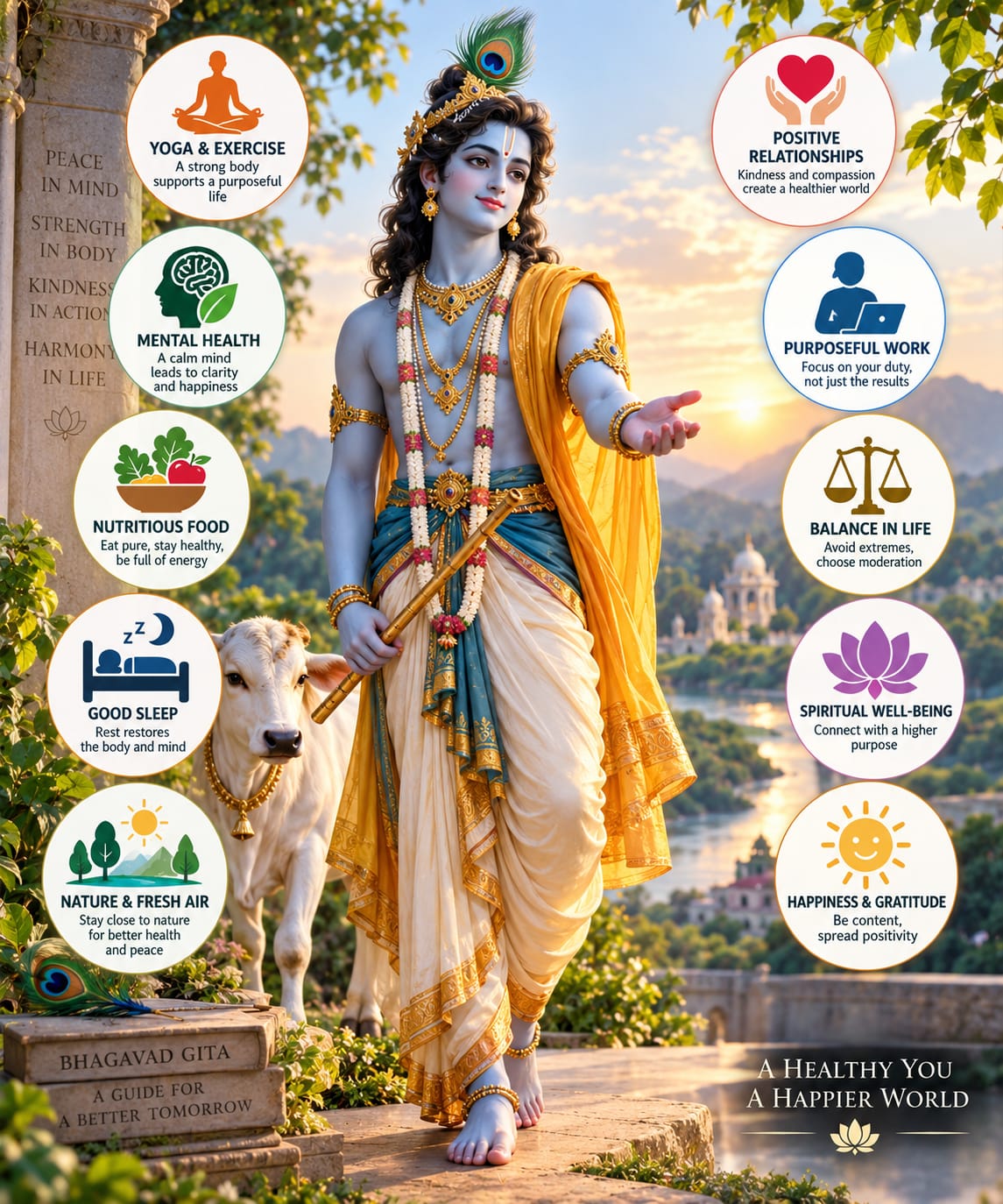
The teachings of Lord Krishna in the Bhagavad Gita extend far beyond yoga. They address many dimensions of human life—how we manage the mind, how we respond to stress, how we eat and sleep, how we work, how we handle success and failure, and how we develop self-control and inner peace.
In today’s world, where lifestyle-related health challenges, stress and emotional exhaustion are increasingly common, these timeless principles can provide a framework for balanced and purposeful living.
1. Mental Health: Make the Mind Your Friend
Krishna explains that the mind can either support us or become a source of difficulty.
उद्धरेदात्मनात्मानं नात्मानमवसादयेत्।
आत्मैव ह्यात्मनो बन्धुरात्मैव रिपुरात्मनः॥
— भगवद्गीता 6.5
Meaning: A person should uplift themselves through their own mind rather than allowing the mind to bring them down. A disciplined mind becomes a friend, while an uncontrolled mind can become an enemy.
The modern lesson is the importance of self-awareness, emotional regulation and constructive thinking. Meditation, reflection, meaningful conversations and seeking professional support when needed can all contribute to mental well-being.
2. Food: Eat With Awareness and Moderation
Krishna discusses the importance of food and its influence on our qualities and state of mind.
आयुःसत्त्वबलारोग्यसुखप्रीतिविवर्धनाः।
रस्याः स्निग्धाः स्थिरा हृद्याः आहाराः सात्त्विकप्रियाः॥
— भगवद्गीता 17.8
Meaning: Foods that promote longevity, vitality, strength, health, happiness and satisfaction are described as desirable for a sattvic lifestyle.
The broader message is to favour nutritious, wholesome food and avoid excessive eating or unhealthy extremes.
3. Sleep and Daily Routine
Krishna specifically connects well-being with moderation in eating, activity, sleep and wakefulness.
युक्ताहारविहारस्य युक्तचेष्टस्य कर्मसु।
युक्तस्वप्नावबोधस्य योगो भवति दुःखहा॥
— भगवद्गीता 6.17
Meaning: A balanced approach to food, recreation, work, sleep and wakefulness supports a life of greater well-being.
A healthy lifestyle therefore requires regularity and balance, rather than extreme routines.
4. Emotional Health: Stay Balanced in Success and Failure
Life inevitably brings both achievement and disappointment. Krishna encourages a person to remain steady instead of allowing circumstances to completely control their emotional state.
सुखदुःखे समे कृत्वा लाभालाभौ जयाजयौ।
ततो युद्धाय युज्यस्व नैवं पापमवाप्स्यसि॥
— भगवद्गीता 2.38
Meaning: Remain balanced in happiness and distress, gain and loss, victory and defeat, and continue performing your duty.
This principle can inspire emotional resilience—celebrating success without arrogance and facing setbacks without losing hope.
5. Work: Focus on Action, Not Constantly on Results
One of Krishna’s best-known teachings is:
कर्मण्येवाधिकारस्ते मा फलेषु कदाचन।
मा कर्मफलहेतुर्भूर्मा ते सङ्गोऽस्त्वकर्मणि॥
— भगवद्गीता 2.47
Meaning: We have control over our actions, but not complete control over their outcomes.
For modern life, this can be understood as encouraging people to focus on effort, preparation and responsible action instead of constantly worrying about outcomes.
6. Relationships: Compassion and Respect
Krishna describes qualities of a person who is dear to Him, including compassion, friendliness, freedom from excessive ego and the ability to remain balanced.
अद्वेष्टा सर्वभूतानां मैत्रः करुण एव च।
निर्ममो निरहङ्कारः समदुःखसुखः क्षमी॥
— भगवद्गीता 12.13
Meaning: One who bears no hatred toward living beings, is friendly and compassionate, free from excessive possessiveness and ego, and remains balanced in happiness and sorrow is described as spiritually mature.
Healthy relationships are an important part of a fulfilling life. Kindness, empathy, forgiveness and respect can strengthen families and communities.
7. Purpose: Live With Meaning
Krishna repeatedly encourages Arjuna to understand his responsibilities and act with purpose.
A healthy life is not merely about living longer. It is also about living meaningfully—having responsibilities, contributing to others and developing one’s abilities.
Purpose can provide direction when life becomes difficult.
8. Self-Control: Discipline Over Impulse
Krishna emphasizes mastery over the senses and mind. Self-control does not mean denying every pleasure; it means not becoming controlled by every impulse.
This principle is highly relevant today in areas such as:
Excessive screen use
Unhealthy eating
Lack of sleep
Anger and impulsive reactions
Overwork
Constant consumption of entertainment
Healthy living requires the ability to pause, choose and act consciously.
9. Simplicity and Contentment
Constant comparison can create dissatisfaction. Krishna’s teachings encourage inner stability rather than dependence on external circumstances.
Practising gratitude, simplicity and contentment can help shift attention from what is missing to what is meaningful.
10. Spiritual Well-Being
For Krishna, human well-being ultimately goes beyond the physical body. Spiritual awareness, devotion, self-knowledge and connection with a higher purpose are important aspects of life.
मन्मना भव मद्भक्तो मद्याजी मां नमस्कुरु।
मामेवैष्यसि युक्त्वैवमात्मानं मत्परायणः॥
— भगवद्गीता 9.34
Meaning: Fix your mind on Me, become devoted to Me, offer your actions to Me and bow to Me; thus, with your consciousness directed toward Me, you can attain Me.
For believers, devotion can become a source of hope, meaning, gratitude and inner strength.
Krishna’s Holistic Healthy-Living Formula
🌿 Nutritious food
💧 Moderation
😴 Healthy sleep
🧠 Mental discipline
❤️ Compassionate relationships
💼 Purposeful work
🎯 Focus on effort
🧘 Mindfulness and self-awareness
🙏 Spiritual connection
🌸 Contentment and inner balance
The Central Message
Lord Krishna’s teachings can be viewed as a reminder that true health is multidimensional. A person needs more than physical fitness. Mental peace, emotional resilience, healthy relationships, meaningful work, disciplined habits and spiritual well-being can all contribute to a balanced life.
The goal is not an extreme lifestyle. It is a balanced life—where the body is cared for, the mind is trained, emotions are managed, relationships are nurtured and life is guided by purpose.