
New Delhi: July 10, 2026
In a move aimed at curbing the misuse of alcohol-based medicinal products, the Ministry of Health and Family Welfare has amended the Drugs Rules, 1945, bringing stricter regulation to formulations containing high levels of ethyl alcohol.
Under the revised rules, medicinal formulations containing more than 12% v/v ethyl alcohol and sold in quantities exceeding 30 mL will no longer enjoy the licensing exemption previously available under Schedule K of the Drugs Rules. Manufacturers and sellers of these products will now be required to obtain the necessary licences under the Drugs and Cosmetics Act, 1940.
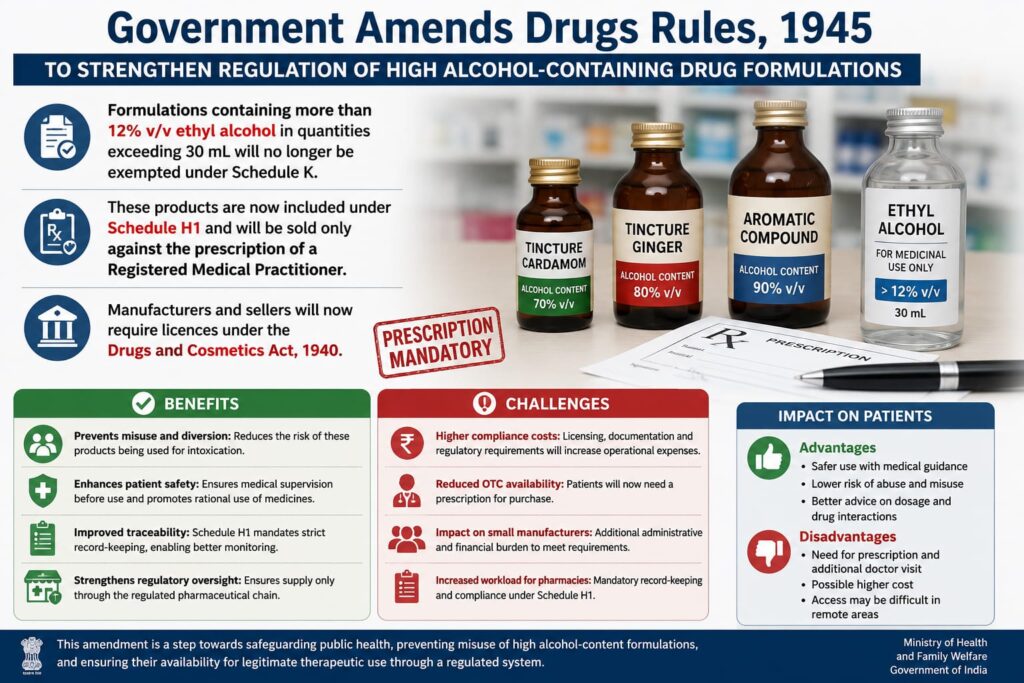
The government has also brought these formulations under Schedule H1, making them prescription-only medicines. Their sale will now require a valid prescription from a registered medical practitioner, and pharmacies must maintain detailed records of their distribution in accordance with Schedule H1 requirements.
The decision follows concerns that several products exempted under Schedule K—such as certain tinctures of cardamom, ginger and other aromatic medicinal preparations—contain very high concentrations of ethyl alcohol, in some cases reaching 80–90% v/v. Authorities noted that such products have the potential to be diverted for non-medicinal use, with several state governments highlighting instances of misuse.
According to the Health Ministry, the amendment is intended to strengthen oversight of alcohol-containing medicinal formulations without affecting their legitimate therapeutic use. By bringing these products into the regulated pharmaceutical supply chain, the government aims to reduce the risk of diversion while ensuring that patients who genuinely need them continue to have access through authorised medical channels.
The latest amendment is part of the Centre’s broader efforts to reinforce India’s drug regulatory framework, encourage the responsible use of medicines and enhance safeguards for public health.
The amendment has implications for both the pharmaceutical industry and patients. While it is designed to improve public safety, it also introduces additional compliance requirements.
Potential Benefits & Potential Challenges
Reduced misuse: High alcohol-containing medicinal formulations will be less likely to be diverted for intoxication.
Higher compliance costs: Manufacturers and distributors will need to obtain licences and comply with Schedule H1 requirements.
Better patient safety: Prescription-only sale ensures medical supervision before use. Possible price increase: Additional regulatory compliance may marginally increase production and distribution costs.
Improved traceability: Schedule H1 requires pharmacies to maintain sales records, making monitoring easier.
Reduced over-the-counter availability: Patients who previously purchased these medicines directly will now need a doctor’s prescription.
Stronger quality control: Licensing requirements bring these products under tighter regulatory oversight. Impact on small manufacturers: Smaller companies may face administrative and financial burdens to meet the new requirements.
Prevents illegal diversion: Restricts access through the regulated pharmaceutical supply chain. Workload for pharmacies: Retail chemists must maintain prescription records and comply with stricter documentation norms.
Impact on Patients
Advantages
Greater assurance that medicines are used only for genuine medical conditions.
Lower risk of abuse and accidental misuse.
Better medical guidance on dosage and interactions.
Disadvantages
Patients may need an additional doctor visit to obtain a prescription.
Access could become more difficult in remote areas where medical practitioners are scarce.
Some products may become slightly more expensive if compliance costs are passed on.
Impact on the Pharmaceutical Industry
Overall, the amendment is expected to improve public health and reduce misuse of high alcohol-content medicinal formulations, though it may increase compliance costs for the pharmaceutical sector and make access slightly less convenient for some patients.