
New Delhi | HL July 3, 2026
In one of the most comprehensive environmental initiatives undertaken in the national capital, the Delhi Government has announced a seven-year, Rs. 8,300-crore “Clean Air, Healthy Delhi” programme with financial support from the World Bank, while simultaneously introducing a permanent winter pollution framework aimed at tackling recurring air quality crises.
The twin initiatives signal a shift from seasonal firefighting to long-term scientific planning, with the government focusing on reducing emissions at their source, strengthening enforcement, improving monitoring systems and increasing public participation.
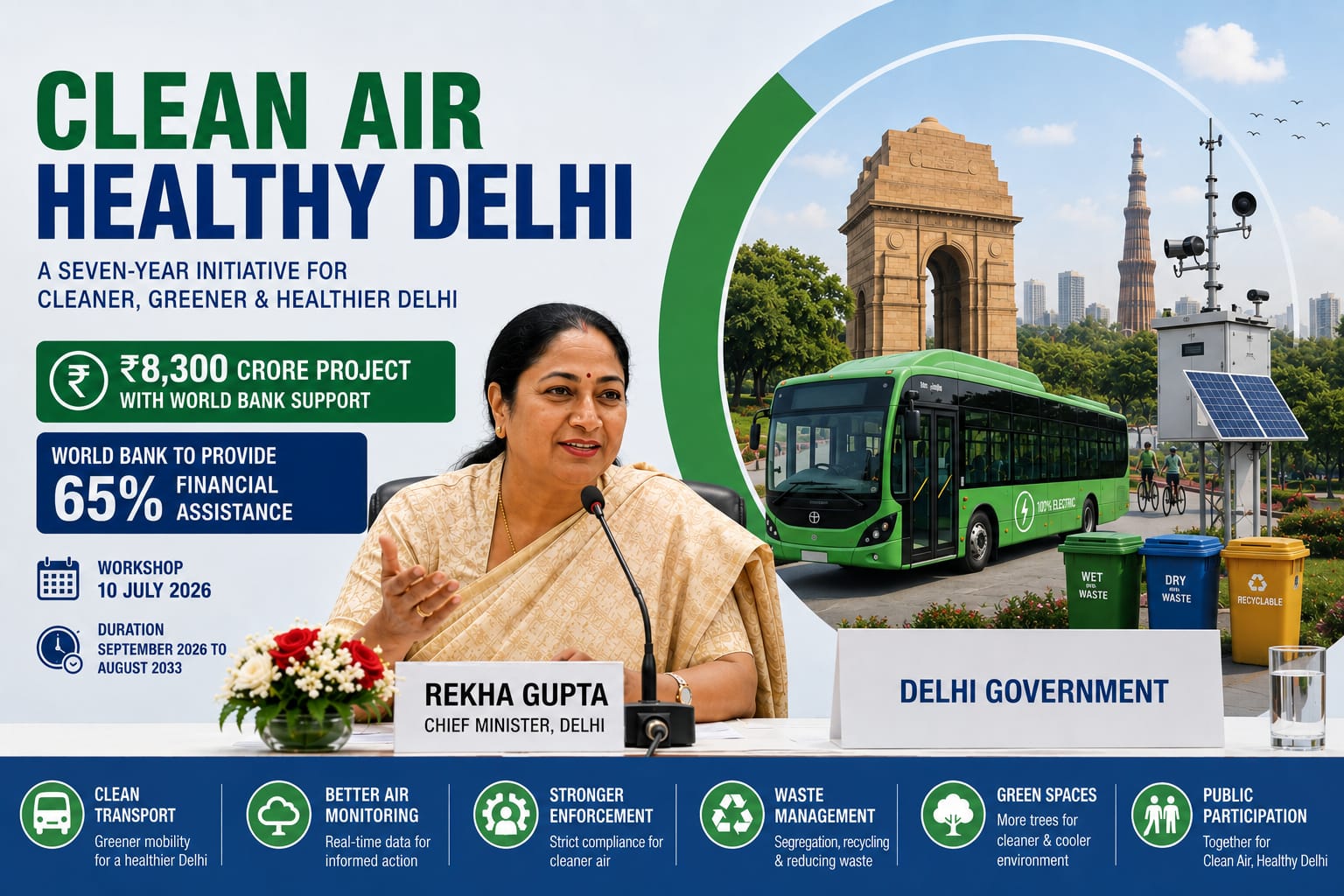
Chief Minister Rekha Gupta said the “Clean Air, Healthy Delhi” project will be implemented from September 2026 to August 2033 across all districts of Delhi. The World Bank will provide 65 percent of the project cost, while the remaining 35 percent will be funded by the Delhi Government.
A high-level workshop involving government departments, key implementing agencies and senior World Bank officials has been scheduled for July 10 to finalise implementation strategies, define departmental responsibilities and establish coordination mechanisms before the project is rolled out.
Delhi’s Air Pollution Challenge
Delhi continues to face one of the country’s most complex air pollution challenges. During winter, pollution levels frequently reach the “Very Poor” and “Severe” categories as emissions from vehicles, industries, construction dust, road dust, biomass burning and unfavourable weather conditions combine to trap pollutants close to the ground.
While particulate matter (PM2.5 and PM10) remains the most visible concern, experts have increasingly highlighted rising ground-level ozone pollution during summer months. Unlike the protective ozone layer in the upper atmosphere, ground-level ozone is formed when sunlight reacts with pollutants emitted from vehicles and industries. Exposure can trigger breathing difficulties, worsen asthma and reduce lung function.
Lead contamination also remains an environmental concern despite the phase-out of leaded petrol years ago. Lead particles can still originate from industrial activities, battery recycling units, electronic waste processing and contaminated dust. Long-term exposure can adversely affect children’s brain development, cardiovascular health and overall public health.
Environmental experts have repeatedly stressed that Delhi’s pollution challenge cannot be solved through emergency measures alone and requires year-round interventions supported by technology, scientific data and regional cooperation.
Two-Pillar Strategy for Cleaner Air
According to the Chief Minister, the Clean Air, Healthy Delhi project has been designed around two major pillars.
The first focuses on strengthening air quality management. A dedicated Project Management Unit (PMU) will oversee implementation while modern air quality monitoring infrastructure, advanced data analytics and an Integrated Command and Control Centre (ICCC)-based monitoring platform will provide real-time assessment of pollution levels. The project also aims to improve coordination among departments, promote scientific planning, encourage innovation, increase public awareness and strengthen collaboration with neighbouring Indo-Gangetic Plain states to address transboundary pollution.
The second pillar targets direct reduction of pollution from major emission sources. The government plans to phase out ageing and highly polluting vehicles, accelerate electric vehicle adoption, strengthen public transport systems, modernise Pollution Under Control (PUC) monitoring and tighten compliance mechanisms for vehicle emissions.
The project will also focus on reducing emissions from transport, construction and demolition waste, road dust, solid waste management, industries, green spaces and water pollution.
Permanent Winter Pollution Framework
Complementing the long-term project, the Delhi Government has also notified permanent winter pollution regulations that will automatically come into force every year from November 1 to February 28.
Unlike previous years when separate orders were issued each winter, the new notification establishes a standing regulatory framework covering vehicular emissions, construction activities, dust control, waste burning and workplace practices.
Among the most significant measures is the decision to deny fuel to vehicles without a valid Pollution Under Control (PUC) certificate throughout the year. Verification will be carried out through integrated digital databases in addition to physical certificates.
From November through January, non-Delhi registered vehicles below BS-VI emission standards will not be permitted to enter the capital, except for exempted categories such as emergency services, CNG and electric vehicles.
To reduce congestion and vehicular emissions, authorised parking charges will be doubled during winter months, while staggered office timings and a 50 percent work-from-home policy will apply to government and private offices, excluding essential services.
Stronger Controls on Construction and Dust
Recognising construction dust as one of Delhi’s largest pollution sources, the government has introduced stricter dust-control measures.
Demolition work and dust-generating civil construction activities will remain prohibited from November 1 to January 31, except for essential public infrastructure projects. During the peak pollution window between December 10 and January 20, only critical public utility and emergency government projects will be allowed to continue.
Commercial buildings larger than 3,000 square metres and buildings taller than G+5 will be required to install anti-smog guns or mist systems by August 15. Construction sites exceeding 1,000 square metres must also deploy permanent dust suppression systems.
Zero Tolerance Towards Open Burning
The new framework also introduces institutional accountability for open burning of waste, leaves and biomass.
Resident Welfare Associations, housing societies, government institutions, contractors and private organisations will be held responsible if open burning occurs within areas under their management. Authorities will be empowered to impose penalties under environmental laws, recover environmental compensation and deploy drone surveillance to detect violations, particularly during night hours.
Multi-Agency Implementation
The ambitious clean air programme will involve coordinated action by the Environment Department, Delhi Pollution Control Committee (DPCC), Transport Department, Public Works Department (PWD), Municipal Corporation of Delhi (MCD), Delhi Jal Board (DJB), Delhi Transport Corporation (DTC), Delhi Traffic Police, Delhi Development Authority (DDA), New Delhi Municipal Council (NDMC), Delhi Cantonment Board, Delhi State Industrial and Infrastructure Development Corporation (DSIIDC), Delhi Transco Limited (DTL), Delhi Integrated Multi-Modal Transit System (DIMTS), the Department of Economic Affairs under the Government of India and the World Bank.
A Shift Towards Long-Term Environmental Governance
Officials believe the combination of a large-scale investment programme and permanent regulatory measures marks a transition from short-term emergency responses to sustained environmental governance.
By integrating technology, stricter enforcement, scientific monitoring, cleaner mobility, better waste management and regional cooperation, the Delhi Government aims to improve air quality, protect public health and build a cleaner urban environment in line with the vision of Viksit Bharat 2047.
Chief Minister Rekha Gupta said clean air is a fundamental right of every citizen and emphasised that achieving lasting improvements would require active participation from government agencies, institutions, industries and residents alike. She said the government is committed to ensuring that future generations inherit a healthier, cleaner and more sustainable Delhi.