

By Sandiip / New Delhi : November 2, 2026
Growing concerns about student mental health have prompted fresh action across India’s education system. Gujarat has introduced mandatory mental-health support mechanisms for students in Classes 9 to 12, including School Wellness Teams, qualified counsellors and peer-support representatives called Mano-Mitra. The initiative comes against the backdrop of a serious national concern: according to the National Crime Records Bureau (NCRB), 13,892 students died by suicide in India in 2023, accounting for approximately 8.1% of all reported suicide deaths that year.
Other states are also pursuing different approaches to student well-being. Rajasthan has introduced the Khushishala programme in government primary schools, while other initiatives focus on counselling, peer support, emotional development and access to professional mental-health services. Together, these measures reflect growing recognition that educational institutions must address students’ emotional needs alongside academic achievement.
Gujarat Makes School Mental-Health Support Mandatory
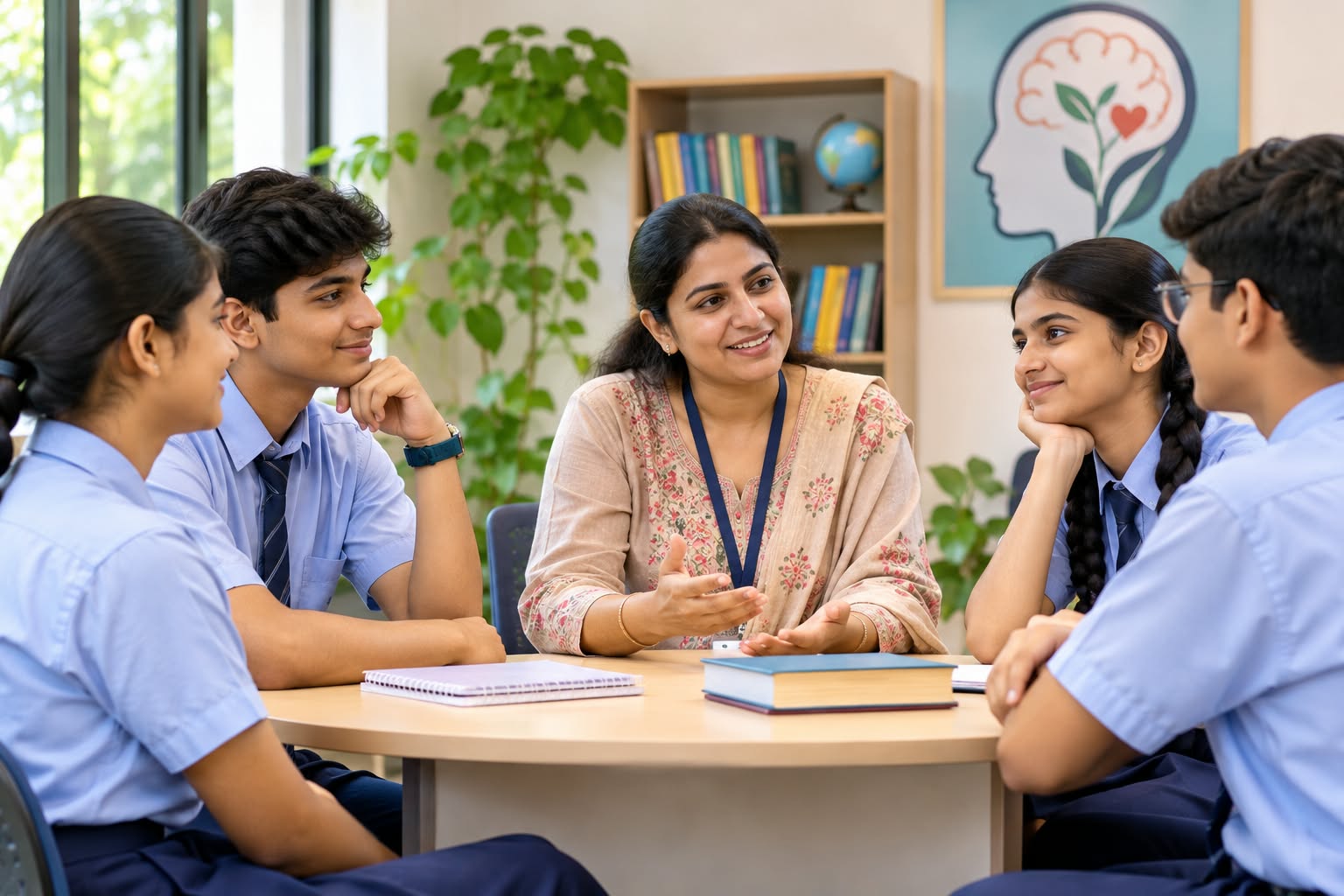
Under the new regulations announced on November 1, 2026, schools affiliated with the Gujarat Secondary and Higher Secondary Education Board (GSHSEB) must establish School Wellness Teams for students in Classes 9 to 12.
The school principal will lead each team, which will include teachers, a school management representative, a non-teaching staff member and two student representatives known as Mano-Mitras.
Schools with 100 or more students must appoint at least one qualified counsellor, psychologist or social worker trained in child and adolescent mental health. Smaller schools must establish formal referral arrangements with external professionals, health centres, district mental-health services and Tele-MANAS.
The framework also calls for additional mentoring during stressful academic periods, including board examinations and the announcement of results.
Another important provision seeks to discourage unhealthy academic competition. Schools are prohibited from humiliating students publicly or segregating them on the basis of examination marks in ways that could harm their emotional well-being.
The initiative draws on the Supreme Court’s student mental-health guidelines and NCERT’s UMMEED framework.
Rajasthan’s Khushishala Focuses on Primary School Children
Rajasthan has adopted a different approach by focusing on children’s emotional development during their early school years.
Launched in June 2026, the Khushishala initiative initially covered approximately 1,500 government primary schools, targeting students in Classes 1 to 5.
Implemented through the Rajasthan State Council of Educational Research and Training (RSCERT), the programme uses classroom activities to promote emotional awareness, social skills, resilience and healthy relationships.
Teachers receive specialised training and learning resources to help them recognise children’s emotional needs and support their development. Following encouraging results from pilot projects, the state announced plans to expand the programme and train more teachers.
The initiative highlights the importance of addressing mental well-being before academic pressure intensifies in secondary school.
Supreme Court Guidelines Provide a National Framework
On July 25, 2025, the Supreme Court issued guidelines addressing student mental health and suicide prevention in educational institutions.
The measures emphasise appropriate counsellor-to-student ratios, confidential support mechanisms, referral procedures, staff training and safeguards against practices such as public humiliation and unhealthy academic pressure.
The guidelines are intended to strengthen institutional responsibility for student well-being and provide a framework for educational institutions nationwide.
CBSE Strengthens Counselling and Career Guidance
The Central Board of Secondary Education (CBSE) has also strengthened its requirements for affiliated schools.
In January 2026, CBSE introduced revised provisions requiring one Counselling and Wellness Teacher for every 500 students, along with career counsellors at a ratio of one per 500 students in Classes 9 to 12.
The revised requirements specify professional qualifications and provide a counselling hub-and-spoke model through which smaller schools can access support.
The measures aim to improve access to emotional support, career guidance, crisis intervention and counselling for students and parents.
National Suicide Statistics Highlight the Urgency
The NCRB recorded 13,892 student deaths by suicide in India in 2023. The figure underscores the need for early identification of distress, accessible counselling and stronger cooperation between schools, families and health professionals.
In Gujarat, a separate news report cited 1,063 student deaths by suicide over a four-year period. However, the precise years covered by this state-level figure must be verified before it is described as a 2020–2025 total.
These figures should be interpreted carefully. They do not establish that academic pressure alone caused the deaths. Student mental health can be affected by multiple interacting factors, including family difficulties, bullying, social isolation, financial hardship and mental-health conditions.
The figures nevertheless highlight the importance of ensuring that students can seek help without fear of stigma, punishment or humiliation.
What More Can States Do?
Prof. Dr. Om Prakash, Professor of Psychiatry and Head of the Department of Geriatric Mental Health at IHBAS, said that making mental health support mandatory in schools and colleges is a welcome step, but its success will depend on effective implementation.
He highlighted that academic pressure, examination stress, bullying, family expectations and emotional difficulties can leave students struggling without knowing where to seek help. He emphasised that every educational institution should have access to trained mental health professionals, confidential counselling services, early identification of students at risk and clear referral pathways.
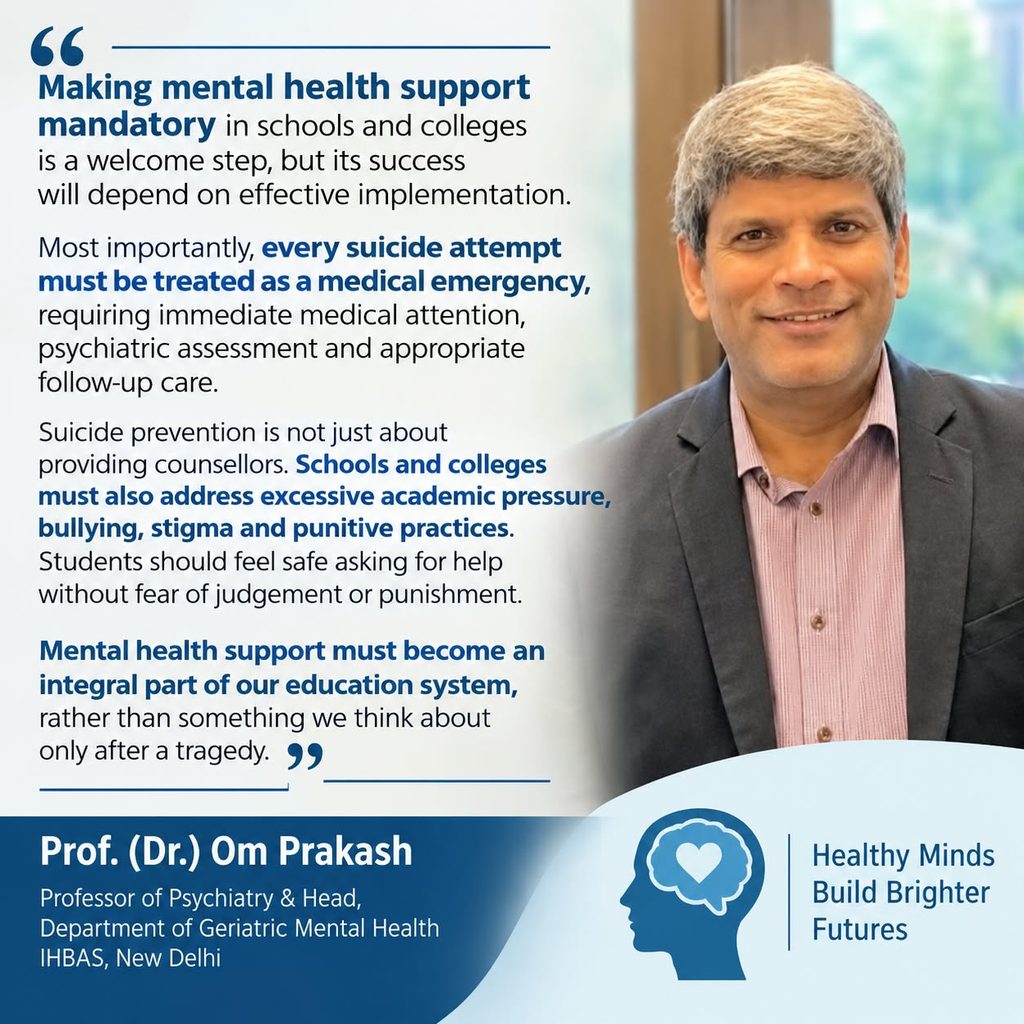
Teachers should also be trained to recognise warning signs and respond appropriately. Stressing the seriousness of suicide attempts, he said that every such incident must be treated as a medical emergency requiring immediate medical attention, psychiatric assessment and appropriate follow-up care, rather than being dismissed as attention-seeking behaviour or treated as a disciplinary issue.
He added that suicide prevention must go beyond appointing counsellors and address excessive academic pressure, bullying, stigma and punitive practices. Students must feel safe seeking help without fear of judgement or punishment. Mental health support must become an integral part of the education system, rather than something addressed only after a tragedy, he said.
Student Well-Being Must Become an Education Priority
Gujarat’s new framework, Rajasthan’s Khushishala programme and CBSE’s counselling requirements represent different approaches to improving student well-being.
Their long-term impact will depend on effective implementation, trained personnel, adequate resources and students’ confidence that seeking help will be met with understanding rather than judgment.
A successful education system must measure its achievements not only through examination results but also through the safety, confidence and emotional well-being of its students.