
New Delhi: HL July 27, 2026
India is strengthening its campaign against viral hepatitis with an expanded focus on prevention, early diagnosis, free treatment and vaccination under the National Viral Hepatitis Control Programme (NVHCP). As the country works towards the global goal of eliminating viral hepatitis as a public health threat by 2030, health authorities are integrating hepatitis services with multiple national healthcare programmes to improve access to care across the country.
Hepatitis is an inflammation of the liver caused by viral infections, alcohol, certain medicines, toxins or autoimmune disorders. Among the five major hepatitis viruses—A, B, C, D and E—Hepatitis B and Hepatitis C pose the greatest long-term health risks as they can lead to chronic liver disease, cirrhosis and liver cancer if left untreated.
Free Diagnosis and Treatment Across India
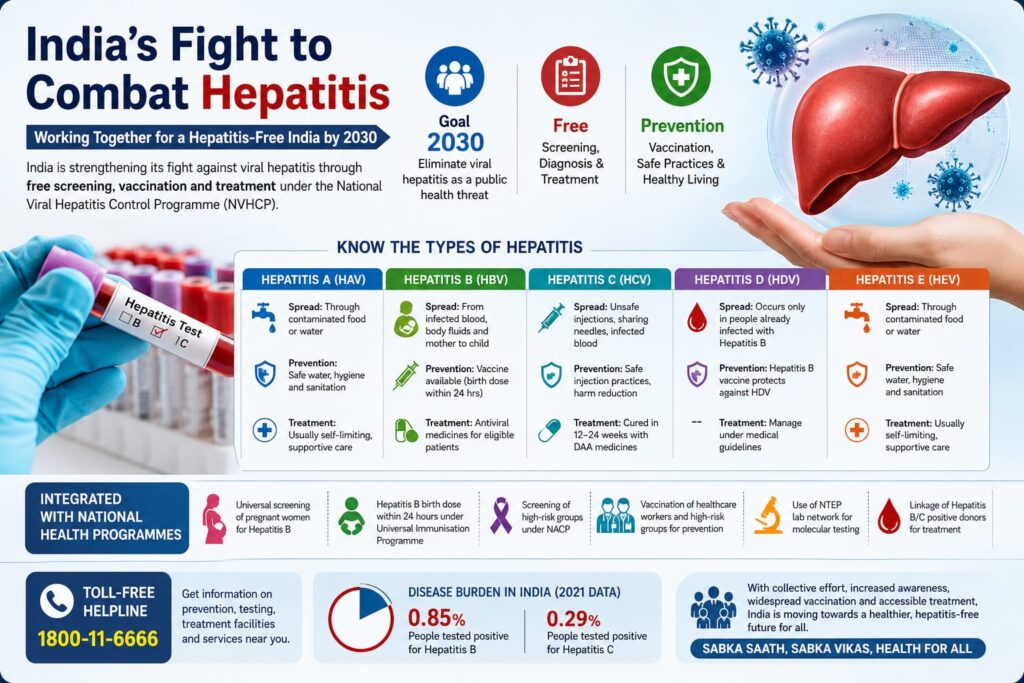
Launched in 2018, the National Viral Hepatitis Control Programme provides free screening, diagnostic tests and medicines for eligible patients with Hepatitis B and Hepatitis C. The programme has adopted a digital monitoring system through the NVHCP Management Information System (MIS), allowing paperless patient registration, treatment tracking and reporting.
Health services are also being expanded from district hospitals to primary healthcare centres, enabling people in rural and remote areas to access testing and treatment closer to their homes.
Understanding the Different Types of Hepatitis
Health experts emphasise that each hepatitis virus spreads differently and requires specific preventive measures.
Hepatitis A and E spread mainly through contaminated food and drinking water. Safe drinking water, improved sanitation and good hygiene remain the most effective preventive measures. These infections are generally self-limiting and managed with supportive care.
Hepatitis B spreads through infected blood, body fluids and from mother to child during childbirth. It is preventable through vaccination, which is included under India’s Universal Immunisation Programme. Antiviral medicines are available for eligible patients with chronic infection.
Hepatitis C spreads primarily through unsafe injections, contaminated medical procedures and sharing needles. Although there is no vaccine, modern Direct-Acting Antiviral (DAA) medicines can cure most patients within 12 to 24 weeks.
Hepatitis D occurs only in people already infected with Hepatitis B. Preventing Hepatitis B through vaccination also protects against Hepatitis D.
Multiple National Programmes Working Together
The government’s hepatitis control strategy is closely linked with several ongoing health initiatives:
Universal Hepatitis B screening for pregnant women.
Hepatitis B birth-dose vaccination within 24 hours of delivery under the Universal Immunisation Programme.
Screening of high-risk groups through the National AIDS Control Programme.
Hepatitis B vaccination for healthcare workers and vulnerable populations.
Molecular testing support through the National Tuberculosis Elimination Programme.
Referral and follow-up of Hepatitis B and C-positive blood donors through blood transfusion services.
Disease Burden in India
According to India’s 2021 HIV Sentinel Surveillance, around 0.85% of those tested were positive for Hepatitis B, while 0.29% tested positive for Hepatitis C. These figures indicate that viral hepatitis continues to be a significant public health concern, highlighting the importance of widespread screening and timely treatment.
Public Awareness and Helpline
To improve awareness and provide guidance, the programme operates a toll-free helpline (1800-11-6666), offering information on symptoms, prevention, testing, treatment facilities and available government services.
Health officials say that increased vaccination coverage, affordable generic medicines, expanded healthcare access and stronger surveillance systems are expected to accelerate India’s progress towards eliminating viral hepatitis by 2030.